Best Parks for Swimming & Water Access
Perfect for water-loving dogs who need to cool off during Austin summers. These parks offer direct access to Lady Bird Lake or creeks.
Auditorium Shores Off-Leash Area
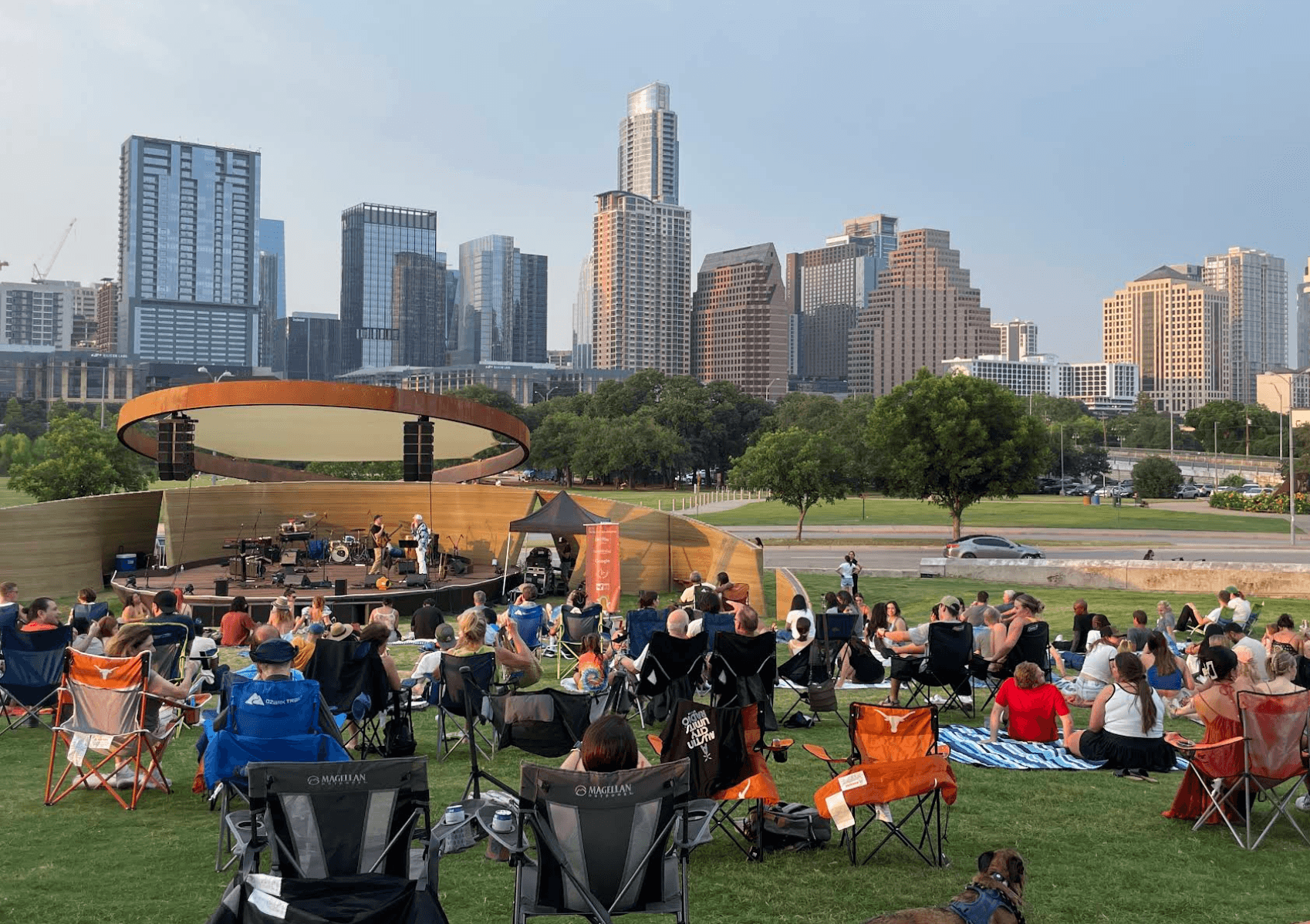
Auditorium Shores Off-Leash Area is Austin's most iconic dog park — a wide, open stretch of Lady Bird Lake waterfront where dogs run free against a backdrop of the downtown skyline. The off-leash area sits along the south shore of Lady Bird Lake near Barton Springs Road, giving dogs direct access to the lake for swimming while owners enjoy one of the best views in the city. On any given morning or evening you'll find dozens of dogs ranging from golden retrievers to pit mixes charging the water, chasing balls across the grass, and socializing with the regular crowd that shows up here daily. The park is unfenced — this is important. Auditorium Shores is a wide open space, not an enclosed dog park, so dogs need solid recall before you bring them here. The lake access is shallow and gradual near the off-leash zone, making it manageable for most dogs that like water. Parking is available in the lot off W Riverside Drive, though it fills up fast on weekend mornings. The surrounding trail connects to the larger Lady Bird Lake hike and bike trail, so many owners combine a dog park visit with a longer walk. Hours are 5am to 10pm daily. No fees. Leashes required outside the designated off-leash area. Waste bags and stations are available on-site. The park can get crowded on weekend mornings — if you have a reactive dog or prefer a quieter environment, weekday early mornings are the best window. Located at 900 W Riverside Dr, Austin, TX 78704, just west of the Lamar Bridge. Austin Parks and Recreation warns that toxic algae has been found in Lady Bird Lake and is most likely present in summer and autumn. It can be fatal to dogs, which are exposed both by drinking and by licking it off their coat afterwards. Avoid floating algae mats and scummy still water at the edges, and rinse your dog with clean water when you leave. Austin's published rules for unfenced off-leash areas are worth knowing here, because this is one of the busiest of them: keep your dog leashed walking to and from the area, keep them within sight and sound control throughout, dogs in heat are not permitted, rabies vaccination is required by state law, and waste has to go in a bin rather than be left at the edge of the grass.
Bartholomew District Park
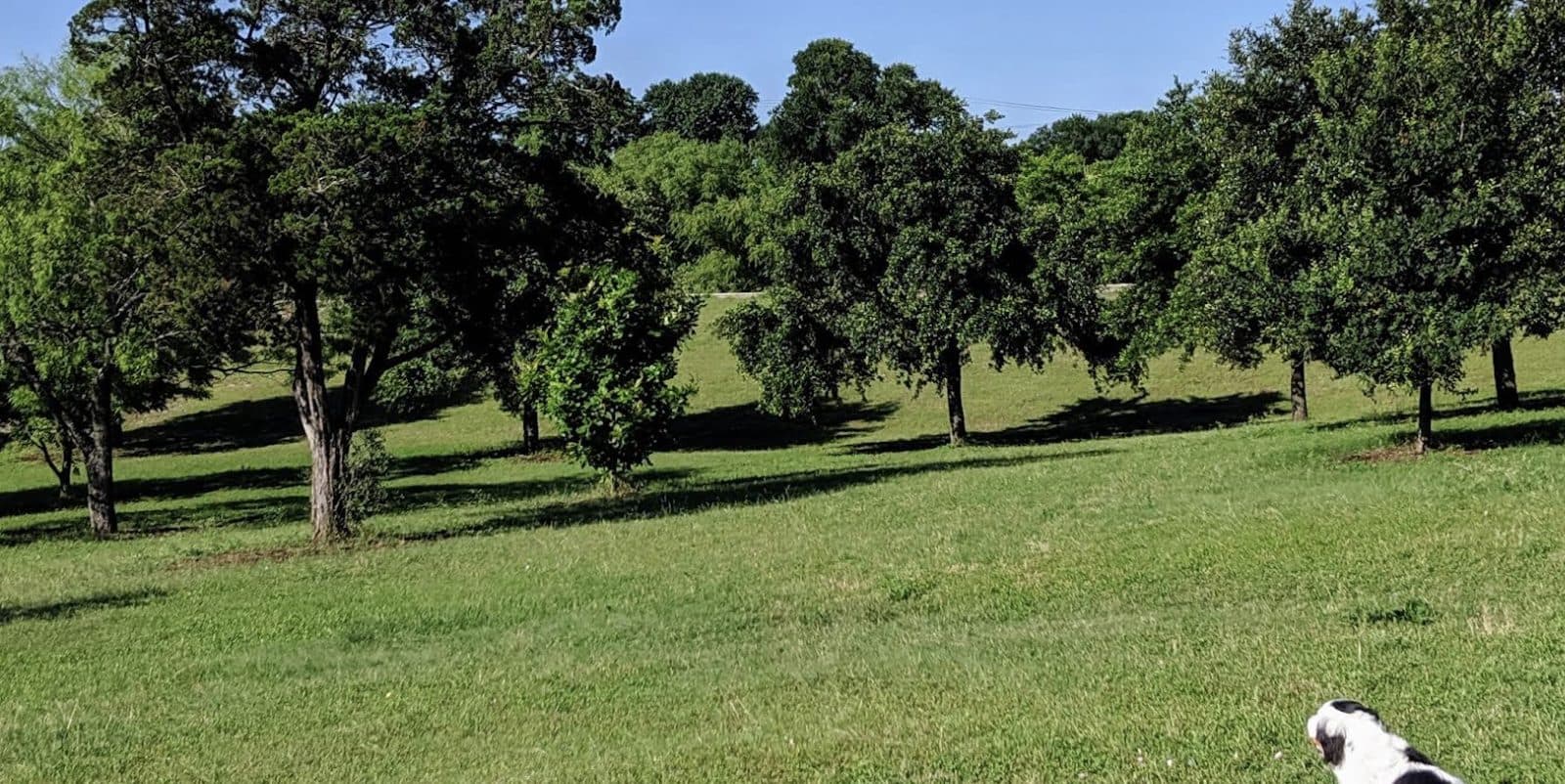
Bartholomew District Park in East Austin has one of the few fully fenced off-leash dog parks on the east side of I-35, making it a convenient option for dog owners in the Mueller, Windsor Park, and Govalle neighborhoods. The park has separate sections for small and large dogs, which helps keep size-mismatched interactions to a minimum and gives smaller dogs a safe space to run without getting overwhelmed. The fenced areas have a mix of grass and packed dirt, some shade trees, and water stations. The park isn't enormous, but for a neighborhood off-leash spot it's well-maintained and regularly used by a friendly, regular crowd. Weekend mornings tend to draw the biggest turnout — which is good for socialization but means the grass takes a beating during dry stretches. Bartholomew is located off Berkman Drive in the 51st Street corridor, with a parking lot off the main park entrance. The broader Bartholomew District Park also has sports fields, picnic areas, and a pool — so it's a full-service park with the dog area as one component rather than the entire property. The wider park is the reason to make it a longer stop. Bartholomew has a municipal pool, sports fields and picnic areas alongside the dog run, so the fenced area is one component of a full-service park rather than the whole destination — useful if someone in the group loses interest in watching dogs. Be realistic about the surface. The enclosure sees heavy daily use from a dense catchment, and in a dry stretch the grass gives way to packed dirt and dust. It recovers after rain, but midsummer is not when this park looks its best. The city's standard rule board applies here as at every Austin off-leash run. The two that catch regulars out are the ban on food and treats — training rewards included — and the requirement to remove prong, pinch or choke collars before entering. Puppies under four months are not permitted, dogs in heat are barred, and holes dug during a visit are the owner's to fill. **One thing to clear up before you go: Google shows a $9 admission for this park. The dog park is free.** That figure is the swimming pool fee. Bartholomew is one of Austin's regional pools, and the city charges daily entry there from AISD spring break through the end of October — $5 adult resident, $9 adult non-resident, less for children, seniors and juniors, free for under-ones and honorably discharged veterans. Google's listing has attached that pool admission to the whole park, which is why it looks like the park charges at the gate. It does not. Austin does not charge admission to city parks, and the fenced off-leash area, the trails, the disc golf course and the picnic areas are all free to use. You only pay if you are getting in the water — which is worth knowing the other way round too, if you were planning to combine a dog park trip with a swim on a July afternoon. The wider park is worth a walk beyond the fence line. The ground rolls rather than sitting flat — low rises and shallow draws with paved paths winding between them — and the tree cover is mature enough to matter, mostly pecan and native hardwoods spaced widely across open grass rather than crowded into a treeline. In spring the redbuds along the slopes come out pink before most of the canopy has leafed, which is the best few weeks of the year to be here. That undulating ground is also why the dog run drains better than some East Austin parks: water moves off it rather than sitting. The trade-off is that the open sections have no shelter at all in July, and the paved loops are exposed for most of their length.
Barton Creek Greenbelt
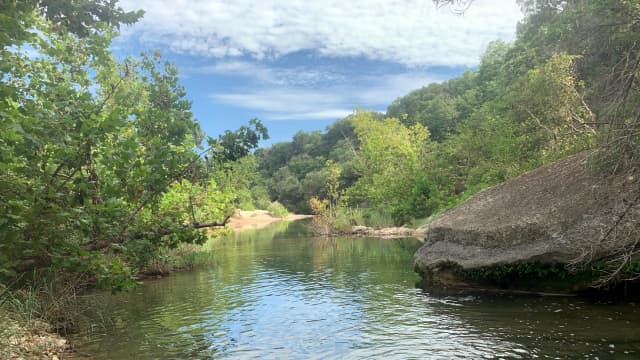
The Barton Creek Greenbelt is one of Austin's most beloved outdoor spaces, and it's genuinely dog-friendly across its nearly 8 miles of trail — leashes are required, but the greenbelt's mix of shaded trails, limestone cliffs, and natural swimming holes makes it one of the best on-leash outings in the city. The creek runs through the entire length of the greenbelt, and multiple spots allow dogs to wade or swim depending on water levels. There are several access points: Barton Springs Road (most popular, fills up fast), Loop 360 at Spyglass, Campbell's Hole, and the Twin Falls entrance. The terrain varies from flat, packed trail near the main entrances to rugged, rocky sections with creek crossings further in. Dogs should be comfortable on uneven terrain for the longer sections. The payoff is real — deep, clear pools surrounded by limestone canyon walls with tree cover that keeps temperatures tolerable even in summer. Water levels vary dramatically with rainfall — after heavy rain, some sections can be inaccessible or unsafe. During dry summers, the swimming holes shrink but rarely disappear entirely. Weekends at the Barton Springs entrance are very crowded; the Twin Falls or Loop 360 entrances are better bets for a quieter hike. Bring water for both you and your dog on longer stretches since creek water quality varies. This is a go-to outing for Austin dog owners and worth the minor logistics. The swimming holes are what people actually come for, and they are worth knowing by name. Campbell's Hole is closest to the Spyglass access and the easiest to reach with a dog. Gus Fruh has deeper water and a cliff wall that draws climbers. Twin Falls and Sculpture Falls sit further south and take a proper walk to reach, which is exactly why they are quieter. How much water is in any of them depends entirely on recent rain. In a dry Austin summer the upper sections can run to standing pools or nothing at all, while the lower holes hold water most of the year. After a storm the creek moves fast enough through the narrow limestone sections to be genuinely dangerous for a dog. Two cautions on the water itself. Austin has recurring problems with toxic algae in its waterways, which can kill dogs — keep them away from mats and scum on still water and rinse them off afterwards. And creek water quality here varies with runoff, so bring drinking water rather than letting your dog rely on the creek. Footing is the other thing to plan for. Much of the greenbelt is loose limestone, exposed root and rock shelf rather than groomed trail. It rewards a sure-footed dog and punishes a clumsy one, and the same goes for whoever is holding the leash.

Bob Wentz Park at Windy Point
Bob Wentz Park is a Travis County park on the north shore of Lake Travis, and there are several things to sort out before you drive out, because a fair amount of what gets written about it online is wrong. It is not free. Day use is $5 per person, $3 for seniors 62 and over, and no charge for children 12 and under or for disabled veterans at 50 percent or greater. **The entrance booth takes cash only** — no cards, no phones, no exceptions — and people do get turned around at the gate over this. If you end up coming often, the $80 Travis County resident annual permit covers day use here and at eight other county parks. Dogs must be leashed everywhere in the park. Off-leash is explicitly prohibited, so despite the swimming this is a lake outing with your dog rather than a dog park in the usual sense. The bigger catch is The Point. That small sandy peninsula with the covered picnic tables and the easiest water access is exactly where you would want to take a dog, and **pets are not allowed on it at all**. Plenty of visitors find this out after parking. There is still plenty of shoreline elsewhere in the 211 acres, but it is rockier limestone rather than sand, so bring something for your feet and expect a less gentle entry into the water. Two water cautions that matter more for dogs than for people. The LCRA advises keeping dogs away from floating algae mats on the Highland Lakes and rinsing them with clean water after they swim — toxic algae has been a recurring problem on Austin waterways and it can be fatal to dogs that lick it off their coat. Zebra mussels have also been found along the shoreline, and their shells are sharp enough to cut paws in the shallows. The park is a well-known windsurfing and sailing spot, which tells you what the conditions are like: it is genuinely windy most days and the surface gets choppy. That is fine for wading and shoreline fetch, less good for a dog inclined to strike out for the middle of the lake. Hours are 8am to 8pm daily, and the gate stops admitting new entries thirty minutes before closing. On holiday weekends the park fills and then closes to all incoming traffic for the rest of the day, including people on foot, so an early start matters more here than at a city park. Drinking fountains, restrooms, showers and covered picnic tables are on site. It is roughly a 30-minute drive from downtown, which along with the entry fee makes this a deliberate weekend trip rather than a stop on the way home.
Bull Creek District Park
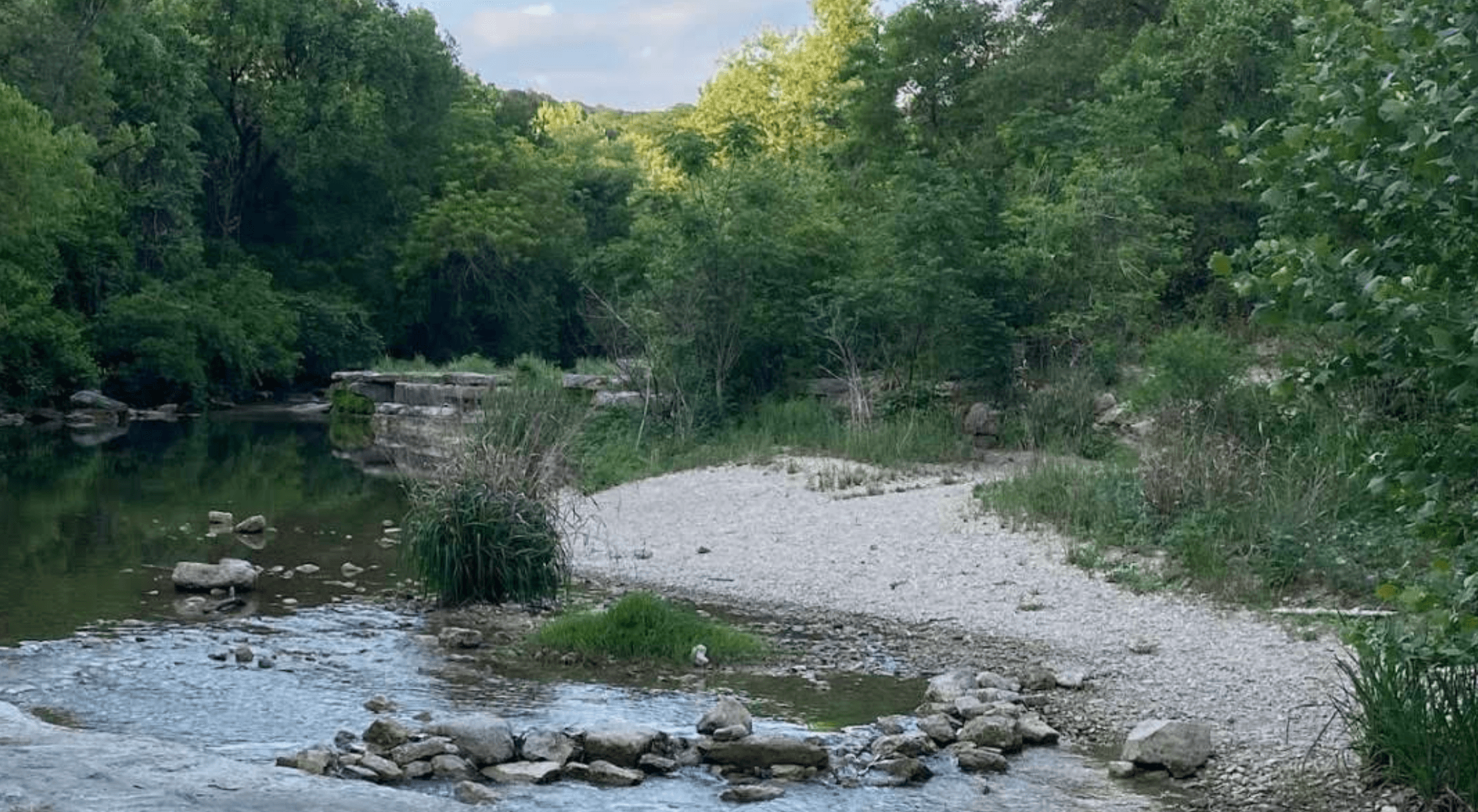
Bull Creek District Park is one of the best places in Austin to be near water with a dog, and also one of the most misreported. It is worth getting the rules right before you go. **This is an on-leash park.** Austin Parks and Recreation removed off-leash privileges here after fecal contamination was found in Bull Creek and off-leash dog use was identified as the likely source. Plenty of what is written about the park online still describes it as a place where the leash rule is loosely observed at the water. We would rather not point you at that: the restriction exists because of a water quality problem in a creek that feeds into Lake Austin, and the dogs standing in it are the reason. Check the posted signage when you arrive, since rules here have changed before and may change again. None of which stops it being a lovely place to take a leashed dog. The limestone creek bed steps down through a series of shallow pools shaded by bluffs and mature trees, and it stays genuinely cool in the middle of a Texas summer when almost nothing else outdoors does. Wading in the shallows on a long lead is most of what people come for. Two cautions on the water. Swimming areas at Bull Creek have been closed at times over blue-green algae, which is toxic to dogs and can kill them — avoid still water with mats or scum on the surface, and rinse your dog afterwards. And the level swings hard with rainfall: after a dry spell the pools shrink to ankle depth, while after a storm the current through the rock channels is stronger than it looks. The footing is rough. This is a natural creek bed, not a groomed park — loose limestone, uneven slabs, and slick rock under the water. Dogs with joint problems or poor balance will find it hard work, and so will you in the wrong shoes. Access is off Lakewood Drive, just south of Loop 360. Parking is free but the lot is small and fills early on any decent weekend; before 9am or after 4pm gives you a realistic chance.
Cedar Bark Park
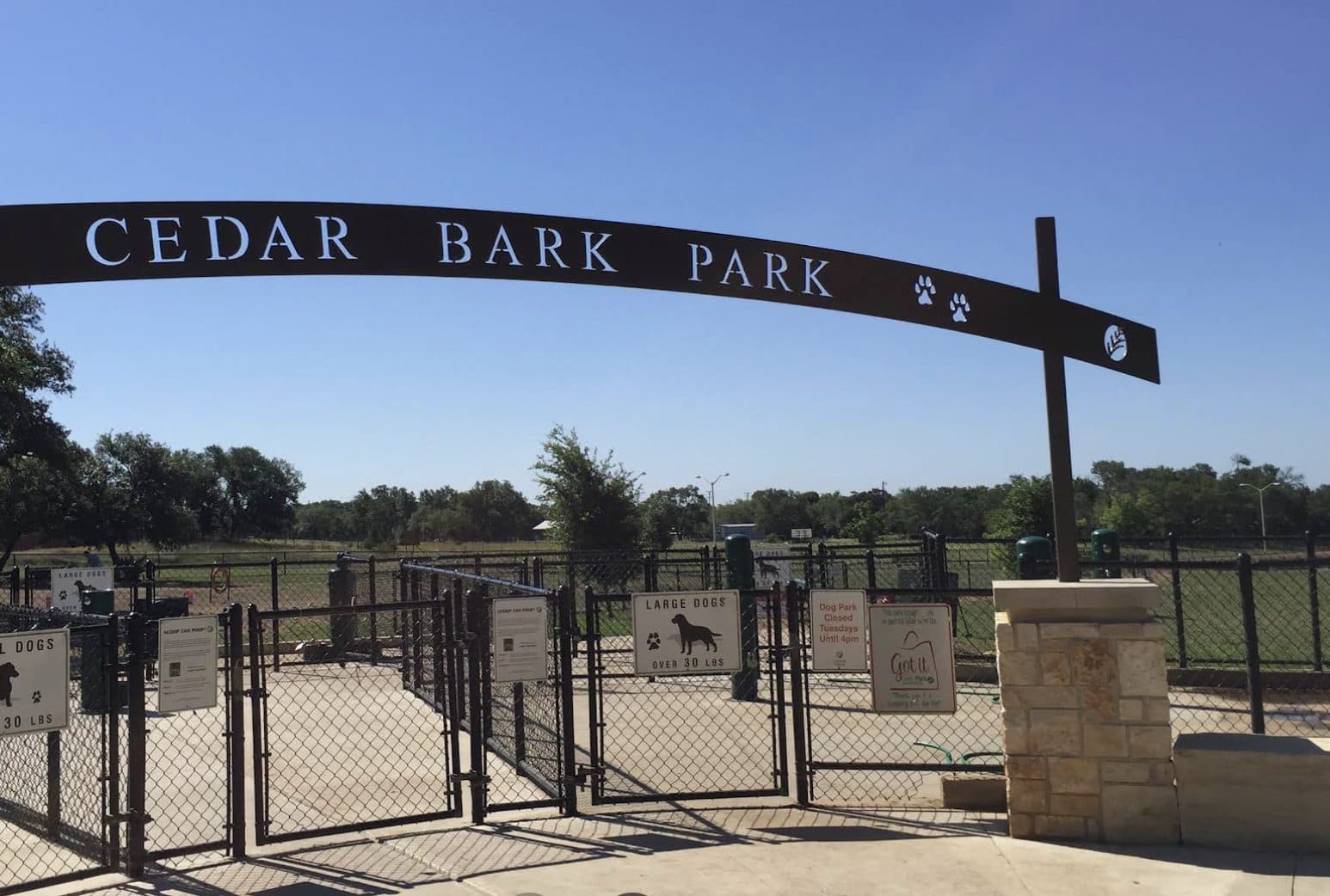
Cedar Bark Park is five fenced acres inside Veterans Memorial Park on West New Hope Drive. It is not at Elizabeth Milburn Park, which is a separate Cedar Park facility a few miles away and a common mix-up. The draw here is water. There's a dog pond for swimming and, more unusually, dog showers on site — so the muddy retriever who just discovered the pond doesn't have to ride home that way. Drinking fountains, waste stations, and benches are spread through the grounds, and the site keeps a fair amount of natural landscape rather than being scraped flat and sodded. Check the day before you drive over, because the maintenance schedule closes the park on two mornings a week. Tuesdays it stays shut from 7am until 3pm, and Fridays from 7am until 11am, while the city services the wash stations and clears trash. Every other day runs 6am to 10pm. Cedar Park asks visitors to be diligent about picking up, and the reason is specific rather than generic: waste left near the pond ends up in the water the dogs are swimming in. The pond is a genuine one rather than a splash pad — a fenced basin with an aerating fountain in the middle and a short dock along one edge. The bank is gravel with a concrete ramp giving dogs a gradual way in and out instead of a drop, and on a warm afternoon there are usually a few standing in the shallows near the ramp rather than swimming properly. Entry is through a double gate, and the small and large sides are split at 30 pounds. In the large field there is a dachshund-shaped tunnel that puppies find considerably more interesting than the adult dogs do.
Pro Tip: Water Safety
Always check Austin Water quality reports before visiting lake parks. Blue-green algae blooms can be toxic. Bring fresh water to minimize lake water consumption.
Best Parks for Small Dogs
These parks feature separate small dog areas to prevent injuries and provide a safer, more comfortable environment for dogs under 25 lbs.
Bartholomew District Park
Bartholomew District Park in East Austin has one of the few fully fenced off-leash dog parks on the east side of I-35, making it a convenient option for dog owners in the Mueller, Windsor Park, and Govalle neighborhoods. The park has separate sections for small and large dogs, which helps keep size-mismatched interactions to a minimum and gives smaller dogs a safe space to run without getting overwhelmed. The fenced areas have a mix of grass and packed dirt, some shade trees, and water stations. The park isn't enormous, but for a neighborhood off-leash spot it's well-maintained and regularly used by a friendly, regular crowd. Weekend mornings tend to draw the biggest turnout — which is good for socialization but means the grass takes a beating during dry stretches. Bartholomew is located off Berkman Drive in the 51st Street corridor, with a parking lot off the main park entrance. The broader Bartholomew District Park also has sports fields, picnic areas, and a pool — so it's a full-service park with the dog area as one component rather than the entire property. The wider park is the reason to make it a longer stop. Bartholomew has a municipal pool, sports fields and picnic areas alongside the dog run, so the fenced area is one component of a full-service park rather than the whole destination — useful if someone in the group loses interest in watching dogs. Be realistic about the surface. The enclosure sees heavy daily use from a dense catchment, and in a dry stretch the grass gives way to packed dirt and dust. It recovers after rain, but midsummer is not when this park looks its best. The city's standard rule board applies here as at every Austin off-leash run. The two that catch regulars out are the ban on food and treats — training rewards included — and the requirement to remove prong, pinch or choke collars before entering. Puppies under four months are not permitted, dogs in heat are barred, and holes dug during a visit are the owner's to fill. **One thing to clear up before you go: Google shows a $9 admission for this park. The dog park is free.** That figure is the swimming pool fee. Bartholomew is one of Austin's regional pools, and the city charges daily entry there from AISD spring break through the end of October — $5 adult resident, $9 adult non-resident, less for children, seniors and juniors, free for under-ones and honorably discharged veterans. Google's listing has attached that pool admission to the whole park, which is why it looks like the park charges at the gate. It does not. Austin does not charge admission to city parks, and the fenced off-leash area, the trails, the disc golf course and the picnic areas are all free to use. You only pay if you are getting in the water — which is worth knowing the other way round too, if you were planning to combine a dog park trip with a swim on a July afternoon. The wider park is worth a walk beyond the fence line. The ground rolls rather than sitting flat — low rises and shallow draws with paved paths winding between them — and the tree cover is mature enough to matter, mostly pecan and native hardwoods spaced widely across open grass rather than crowded into a treeline. In spring the redbuds along the slopes come out pink before most of the canopy has leafed, which is the best few weeks of the year to be here. That undulating ground is also why the dog run drains better than some East Austin parks: water moves off it rather than sitting. The trade-off is that the open sections have no shelter at all in July, and the paved loops are exposed for most of their length.
Cedar Bark Park
Cedar Bark Park is five fenced acres inside Veterans Memorial Park on West New Hope Drive. It is not at Elizabeth Milburn Park, which is a separate Cedar Park facility a few miles away and a common mix-up. The draw here is water. There's a dog pond for swimming and, more unusually, dog showers on site — so the muddy retriever who just discovered the pond doesn't have to ride home that way. Drinking fountains, waste stations, and benches are spread through the grounds, and the site keeps a fair amount of natural landscape rather than being scraped flat and sodded. Check the day before you drive over, because the maintenance schedule closes the park on two mornings a week. Tuesdays it stays shut from 7am until 3pm, and Fridays from 7am until 11am, while the city services the wash stations and clears trash. Every other day runs 6am to 10pm. Cedar Park asks visitors to be diligent about picking up, and the reason is specific rather than generic: waste left near the pond ends up in the water the dogs are swimming in. The pond is a genuine one rather than a splash pad — a fenced basin with an aerating fountain in the middle and a short dock along one edge. The bank is gravel with a concrete ramp giving dogs a gradual way in and out instead of a drop, and on a warm afternoon there are usually a few standing in the shallows near the ramp rather than swimming properly. Entry is through a double gate, and the small and large sides are split at 30 pounds. In the large field there is a dachshund-shaped tunnel that puppies find considerably more interesting than the adult dogs do.
Dog Depot Dog Park
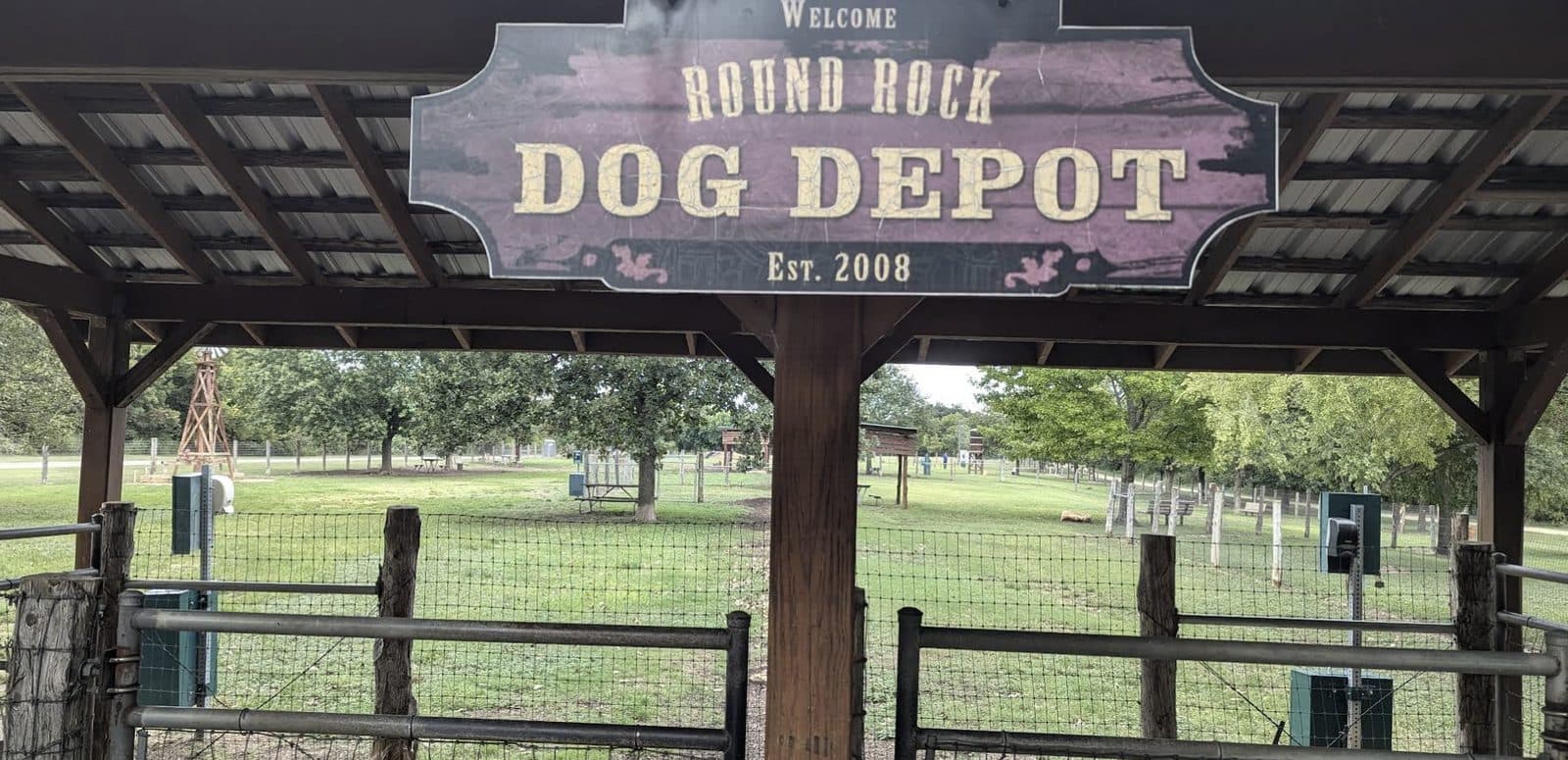
The City of Round Rock calls this Dog Depot Dog Park on its parks pages and the Round Rock Dog Depot in its own descriptions of it; Google lists it under the latter. Same place either way, inside Lake Creek Park on Deerfoot Drive. Round Rock's off-leash park is Dog Depot, 1.85 fenced acres behind the Lake Creek Pool on Deerfoot Drive. Worth stating up front, because it trips people up: this is not at Old Settlers Park. Old Settlers is the bigger name in town and the one people assume, but dogs there are leash-only. The layout is unusual in a way that pays off. There are three sections instead of the usual two — a large dog area, a small dog area for anything under 40 pounds, and a rotation area the city closes off periodically so the grass can recover. That third section is why the footing here holds up better than at most parks getting this much traffic. The gates are winding sally-port entrances, which makes it much harder for a dog to slip past you on the way in or out. Agility equipment is spread through the large side: a tire jump, an A-frame contact ramp, and a tunnel. Two rules catch visitors off guard. No food of any kind is allowed inside, and that includes training treats. And every dog must be both vaccinated and microchipped — Round Rock states it directly rather than burying it in fine print. Hours shift seasonally: 6am to 8pm from April 1 through October 1, then 6am to 6pm from October 2 through March 31. Restrooms are at the Lake Creek Park pavilion outside the fence, in front of the pool, and there are hand sanitizer stations at the gates. The no-food rule deserves emphasis because it catches out anyone who trains with treats as a matter of routine. Round Rock means all food, not just meals, and the reasoning is straightforward: food in a shared enclosure is the most reliable way to start a fight between dogs that were getting along fine. **A navigation note worth having.** The monument sign at the park entrance reads "Lake Creek Park, 800 Deerfoot Lane," while the city's own website, and Google, both give the address as 800 Deerfoot **Drive**. Same place — the dog park sits behind Lake Creek Pool — but if a map app argues with the sign in front of you, the sign is the outlier. The entrance arch dates the park to 2008, and the western theming runs through the whole site: a timber windmill with a water trough at its base, a replica water tower, and rustic pergola shelters rather than the usual metal shade sails. It gives the place more character than the average municipal run, and the pergolas throw proper shade over the seating. There is also a stone-edged wading pool near the entrance, which on a hot afternoon is where you will find at least one dog refusing to leave. It is a genuinely popular park — on a decent weekend morning you can count twenty or more dogs across the large side — so if yours prefers quiet, the seasonal early opening at 6am is the window to use.
Falcon Pointe Garden and Bark Park
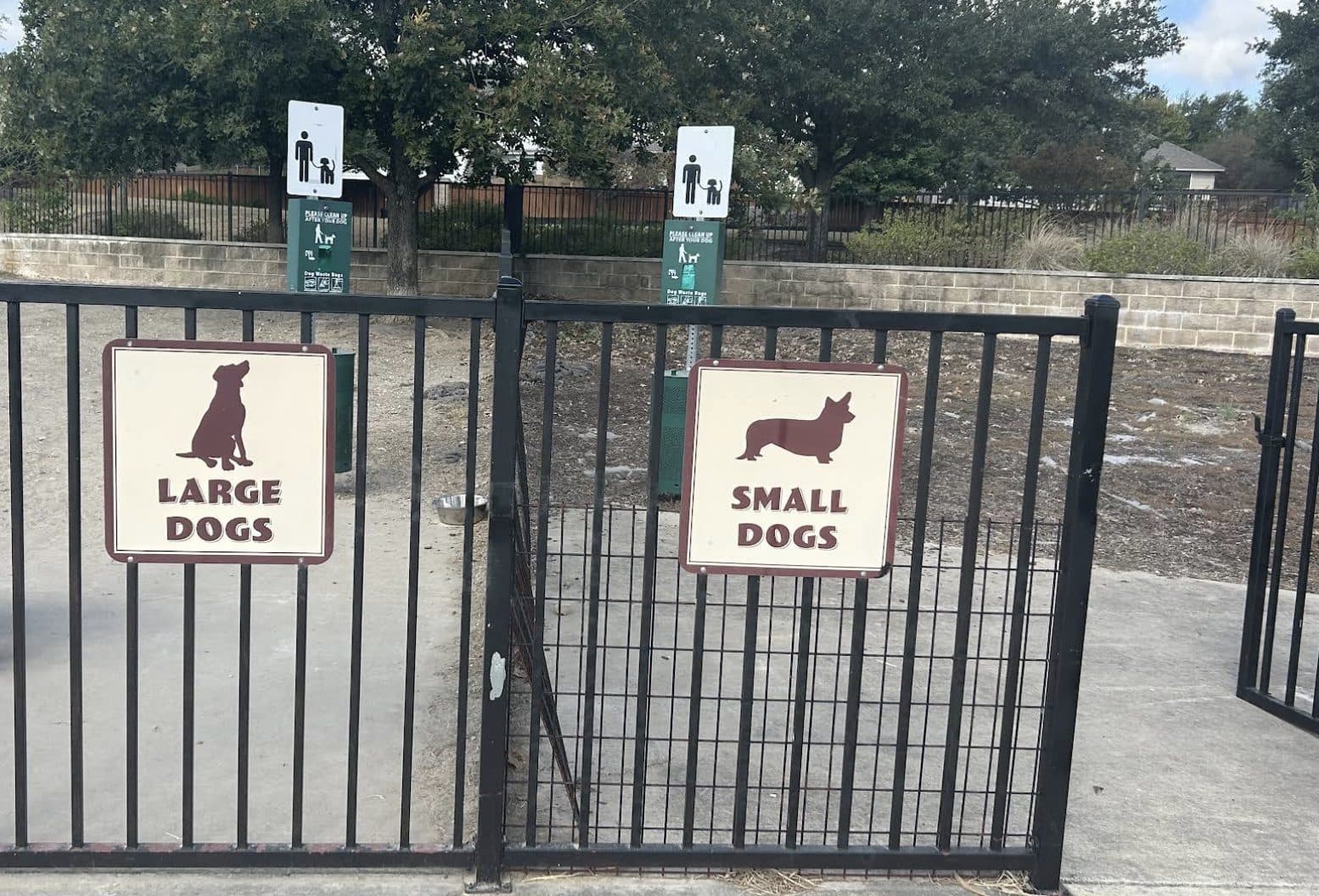
Falcon Pointe's bark park is attached to a demonstration garden, which makes it the odd one out among Pflugerville's off-leash options and the more interesting place to spend an hour. The dog side is 2.65 fenced acres split into separate large and small runs, each with its own gate off a shared concrete apron. Both gates have a waste bag dispenser and there's a water bowl set out between them. Note that the signs are pictures rather than a posted weight limit — a labrador silhouette on one gate, a corgi on the other — so unlike Cedar Bark, where the split is written as 30 pounds, sorting a borderline dog is left to your judgment. The large run is genuinely large, closer to a field than a pen, with real turf rather than the worn dirt a lot of heavily used runs turn into. The ground near the gates is bare and packed from traffic, but it opens up quickly. Mature live oaks along the fence line give proper shade over a decent share of the space, and there are more young trees planted through the middle that will matter in another ten years. A soccer pitch sits immediately beyond the far fence, so on league mornings there's noise and movement on the other side of the rail — which matters if your dog fixates on that sort of thing. What surrounds it is the unusual part. The grounds hold a village of purple martin houses, pear trees, and a set of themed demonstration gardens: rain, culinary, medicinal, butterfly and hummingbird, and native plantings. There's also a moon garden planted for evening visits, built around fragrant white flowers that show up after dark. If you walk your dog at dusk in summer because the afternoon is unbearable, that's more useful than it sounds. The pavilion is the other landmark — a hexagonal shelter with a deep red roof and picnic tables, set on a concrete circle next to a repurposed grain silo. It's the obvious place to wait out a squall or eat something while the dog runs. Open 6am to 10pm, free, with free parking. It sits off Murchison Ridge Trail on Pflugerville's east side. The field is open enough that there's little shelter from wind in winter, and the photographs of it under ice are a reminder that Central Texas does occasionally deliver that.
Garey Park
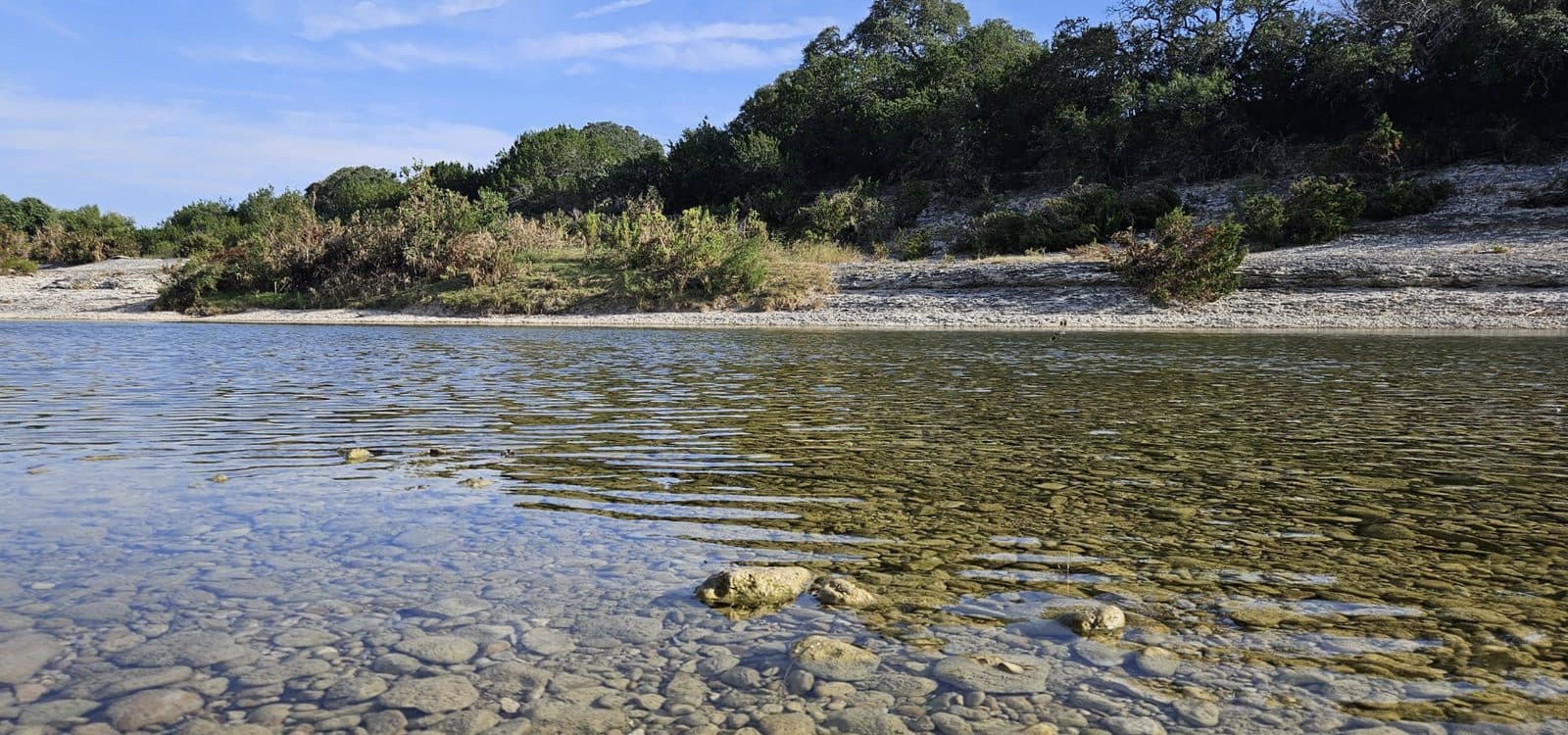
Garey Park's off-leash area is called the Dog Ranch, and it earns the name. Over four fenced acres of natural terrain rather than mown turf — brush, uneven ground, real cover — with separate enclosures for small and large dogs. For a dog that finds flat rectangles boring, this is a different kind of outing. Five shaded picnic shelters sit inside the fence, with water stations and dog-height drinking fountains. The shelters matter more here than at a neighborhood park, because most people stay longer than the usual twenty minutes. The Dog Ranch is one piece of a 525-acre former ranch on the South San Gabriel River, donated to Georgetown and opened to the public. Trails run down toward the water, there's fishing when the river is up, and 4.68 miles of equestrian trail if you ride. It sits about 6.5 miles west of I-35 on RM 2243. Two things separate it from everything else in this directory. It charges admission, and the fee is per vehicle rather than per person: $5 for Georgetown residents and $10 for non-residents, covering a driver and one passenger, with each additional person $2. Annual passes run $100 resident and $150 non-resident. And from October through March, entry is free on Tuesdays — the cheapest way to see whether the drive is worth it. Hours shift with the season: 8am to 8pm from April through September, 8am to 6pm from October through March. Nobody is admitted within 30 minutes of closing, and the park shuts on Thanksgiving, Christmas Eve and Christmas Day. Worth understanding what you are paying for, because Garey is not a drop-in neighborhood run. The entry fee, the drive and the seasonal hours all point the same way: this is a half-day out rather than a twenty-minute leg-stretch. The Dog Ranch is the anchor, but the wider 525 acres — river frontage on the South San Gabriel, trails, an equestrian area and a playground — are what justify the trip. The South San Gabriel is what lifts this above a fenced run with a fee. It comes through the property shallow and startlingly clear over pale limestone cobble, with wide gravel bars on the inside of the bends and slabs of rock big enough to sit on at the edge. In a dry spell it drops to ankle depth threading between exposed rock; after rain it moves. Either way the water is a different proposition from the muddy urban creeks further into Austin. The rest of the grounds are more manicured than the Dog Ranch suggests. There is a spring-fed pond with a fountain and a stone spillway, a pergola on limestone columns, and the restored Garey House with its tile roof looking out over the water — this was a working ranch given to the city, and the homestead end of it is kept accordingly. Beyond that the land rolls away into oak savanna and hill country views, which is where the trail mileage is. **One thing to keep straight: the Garey Play Ranch is not the Dog Ranch.** The Play Ranch is the children's area near the entrance — splash pad, playground, pavilions, its own gated arch and its own posted day-use rules. Dogs are not the point there. The off-leash Dog Ranch is a separate enclosure elsewhere on the property, so follow signs for that specifically rather than the first arch you see.
Georgetown Bark Park
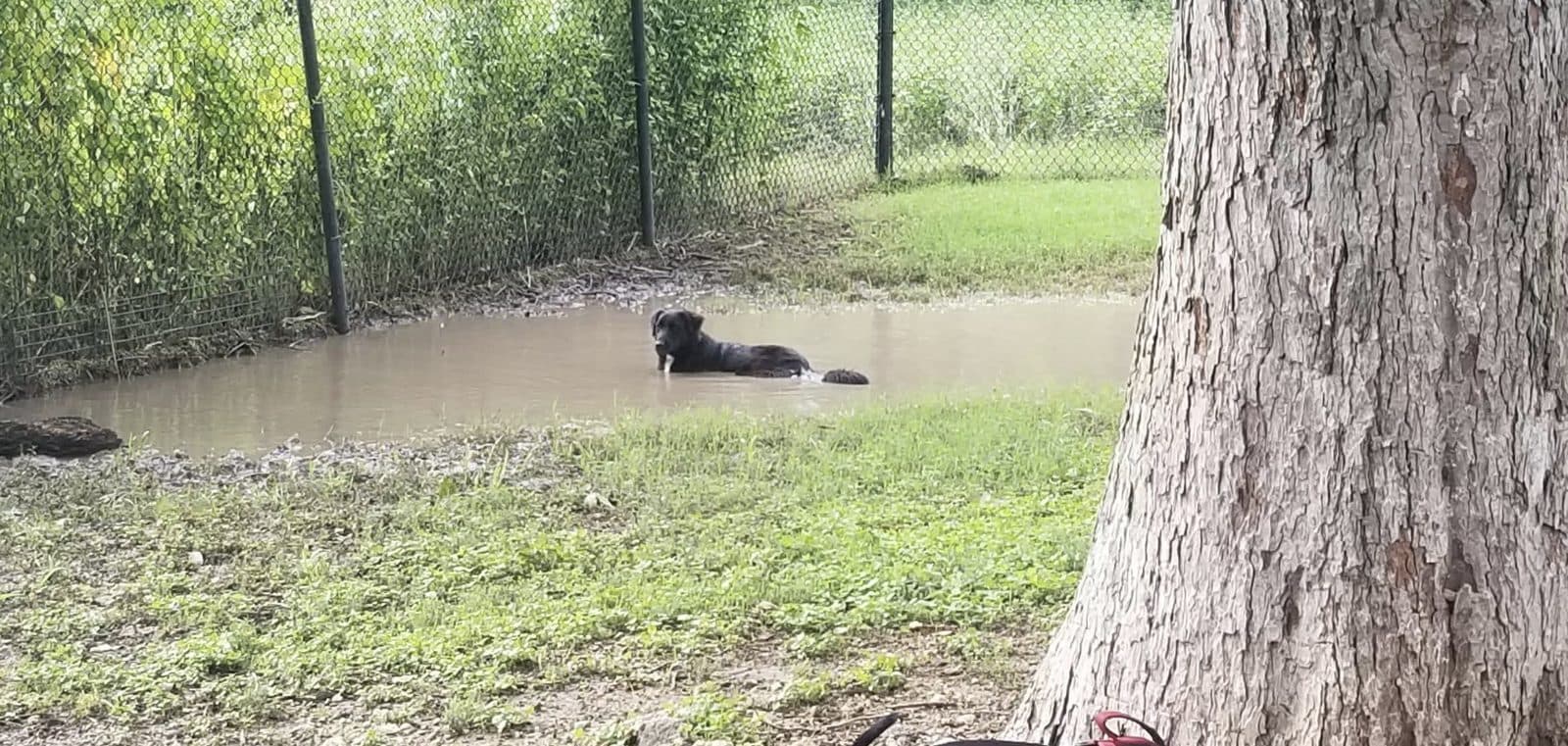
The City of Georgetown calls this simply Bark Park — it was the city's first public off-leash park — and it sits on about six acres on Holly Street, next to the McMaster Complex. The pecan grove is the reason to choose it over a newer park. Most runs in the region are open turf with a couple of young shade structures; this one has mature canopy, which changes what an August afternoon feels like for everyone standing in it. There are two fenced enclosures, split at 30 pounds. That threshold is worth noting if your dog sits near the line, since several parks in the area draw it at 40 and Falcon Pointe posts pictures and leaves the judgment to you — a 35-pound dog is a large dog here and a small dog elsewhere. Both sides have dual drinking fountains serving dogs and people, benches, trash cans and Mutt Mitt dispensers. There is an agility course for dogs that want something to do beyond laps. **Georgetown posts a full rule set and a few items catch people out:** - **Dogs under four months are prohibited.** - **Two dogs per adult**, and every dog must be under an adult's control. - **No food or drink of any kind, for dogs or people — water is the only exception.** - **Spiked collars are not permitted.** - Rabies tags must be attached to the collar, with current license tags worn in the park. - Dogs in heat are prohibited, as are dogs with two documented incidents of aggression. - You must carry a leash at all times, and dogs must be leashed entering and leaving. - **Children under 12 require strict adult supervision**, and running or chasing dogs is prohibited. - No smoking, no glass containers. - Anything you bring in — equipment, waste, toys — has to leave with you. Bites must be reported to Georgetown Police on (512) 930-3510, and rule violations go to Parks and Recreation on (512) 930-3595 within 48 hours. Gates open at 5am and close at 10pm. Parking is on site. Georgetown is roughly 30 minutes north of central Austin, so this is a destination for most Austin residents and a neighborhood park for anyone in Williamson County. The pecan shade makes the drive more defensible in summer than it would otherwise be, and the park rarely reaches the density of the central Austin runs — dogs that find crowding stressful tend to do better here even accounting for the journey. Two things the photographs make plain that a listing never would. The pecan canopy is the real thing — not a few ornamental trees but a proper grove, with the shade spread across most of the enclosure rather than pooled under one structure. And the ground does not drain quickly. After rain, low spots hold standing water for a while, which some dogs treat as the main attraction and their owners treat as a towel problem. Summer swings the other way: by August the grass goes dormant and brown across the open stretches, which looks worse than it plays.

Harris Branch Dog Park
Harris Branch Dog Park is a small neighborhood run in the Harris Branch development in north-east Austin, off Harris Branch Parkway. It is fenced, with separate large and small dog sides connected within the same enclosure, double-gated entry, agility obstacles, benches and water. It is worth setting expectations honestly: this is a pocket park serving the surrounding subdivision, not a destination. Public ratings for it are noticeably lower than for the other fenced parks in this part of the city, and the recurring theme in reviews is size — the small-dog side in particular is compact, and on a busy evening the whole park can feel tight. If you have a dog that needs distance from others to stay comfortable, Northtown up the road is the roomier option. What it does offer is proximity. For anyone living in Harris Branch, Pioneer Crossing or the surrounding 78754 streets, this is a walk rather than a drive, and a fenced space five minutes from home gets used far more often than a better park twenty minutes away. Shade comes from young trees around the perimeter, so it is thinner than at the older parks and the middle is exposed in summer. Waste stations are provided and the grounds are generally kept clean. Parking is on the street alongside the park. Check current hours and any posted rules on arrival — this is a neighborhood facility and signage on site is the reliable source. Being a City of Austin facility, the standard parks board applies: no food or treats, no puppies under four months old, no prong, pinch or choke collars inside, tags showing registration and vaccination, and close adult supervision for children under ten. Owners are also expected to fill in any holes their dog digs.
Historic Stagecoach Park Dog Park
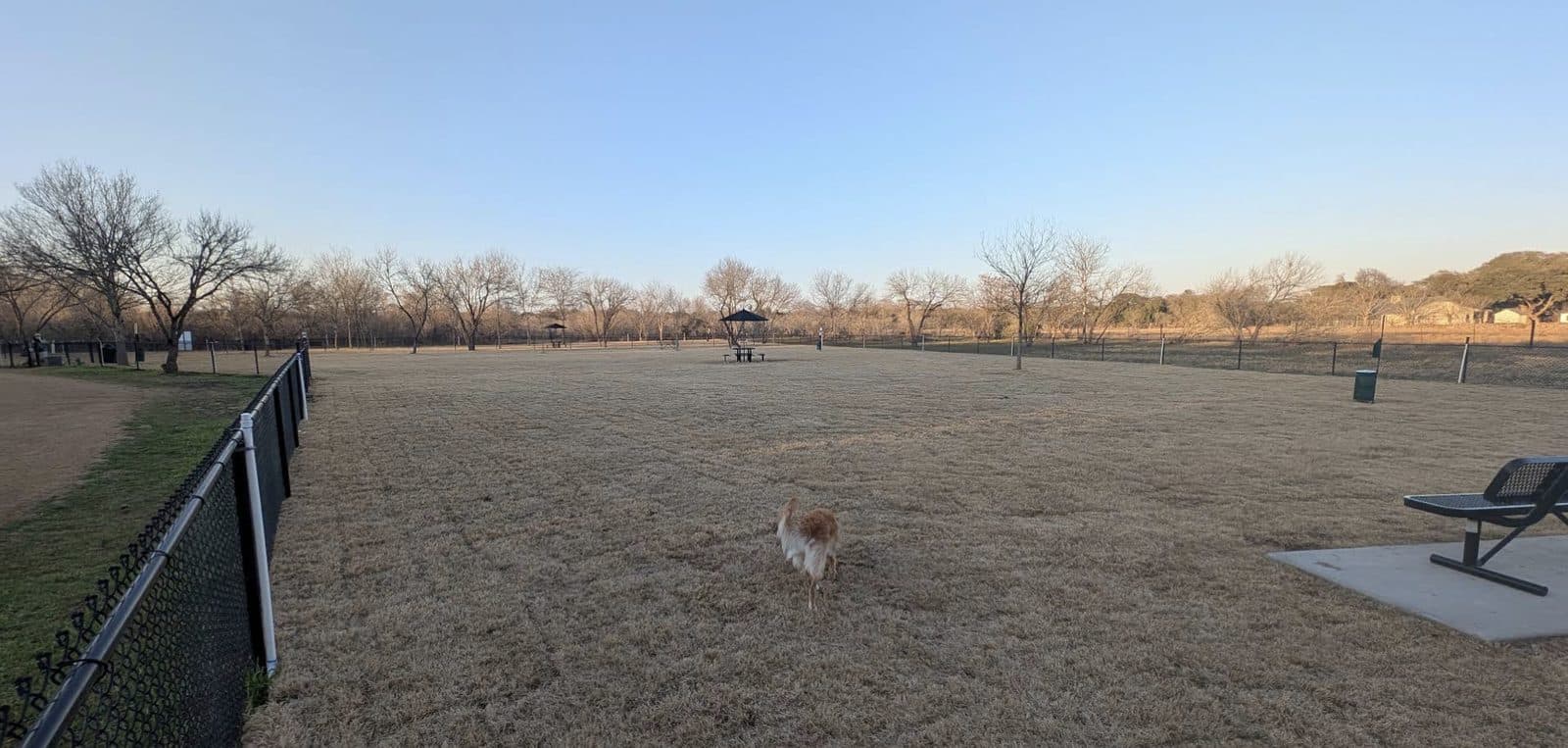
Buda's off-leash park relocated here in January 2026, after the city closed the old Sportsplex site in August 2025 to build new grounds on the east side of Historic Stagecoach Park. If you used the old location, that dog park is gone rather than renamed — this is a new build in a different part of town. The layout is two fenced yards: small dogs under 30 pounds, large dogs 30 and over, each with its own gated entry off a concrete pad. Small dogs are permitted in the large yard, but the posted rules say plainly that it is at your own risk. The large yard is genuinely large — a wide open field rather than a pen — with shade umbrellas, picnic tables, benches and waste stations around the edges. Being a recent build, the perimeter trees are young and thin, so shade is limited in the middle and will stay that way for a few years. **Buda posts a longer and stricter rule list than most parks in the region, and several items are easy to fall foul of.** Under city ordinance 2024-9, adopted September 2024: - **Dogs under four months old are not allowed at all.** Puppy owners should note that before driving over. - **Two dogs per person, maximum.** - **Handlers must be 17 or older.** Anyone under 18 needs an adult with them. - **Pinch, prong and spiked collars must be removed before entering** — a sensible safety rule, but one that catches people who train in them. - **No food of any kind, and no toys.** That includes training treats and human food, not just dog food. - **Collars must display current rabies and registration tags**, and you need the rabies certificate available. - Females in heat are not permitted, and dogs must be healthy and parasite-free. - **You must carry a leash, one per dog, while inside.** - **Professional trainers may not use the facility for training.** - A dog with two documented incidents of aggression is banned from the park. Enforcement has teeth: a violation is a class C misdemeanor carrying a fine of up to $500 per occurrence, per day. Hours shift with the season — 6am to 9pm from March through September, 6am to 7pm from October through February. That winter close means the park shuts before most people finish work for a good chunk of the year, which makes it largely a weekend option from October. The shared grounds are the argument for coming here over a standalone run. The yards sit on the same property as Stagecoach Park's pavilion, amphitheater, playground and trail network, so a dog park visit folds into a longer outing without a second drive.
Northtown Dog Park
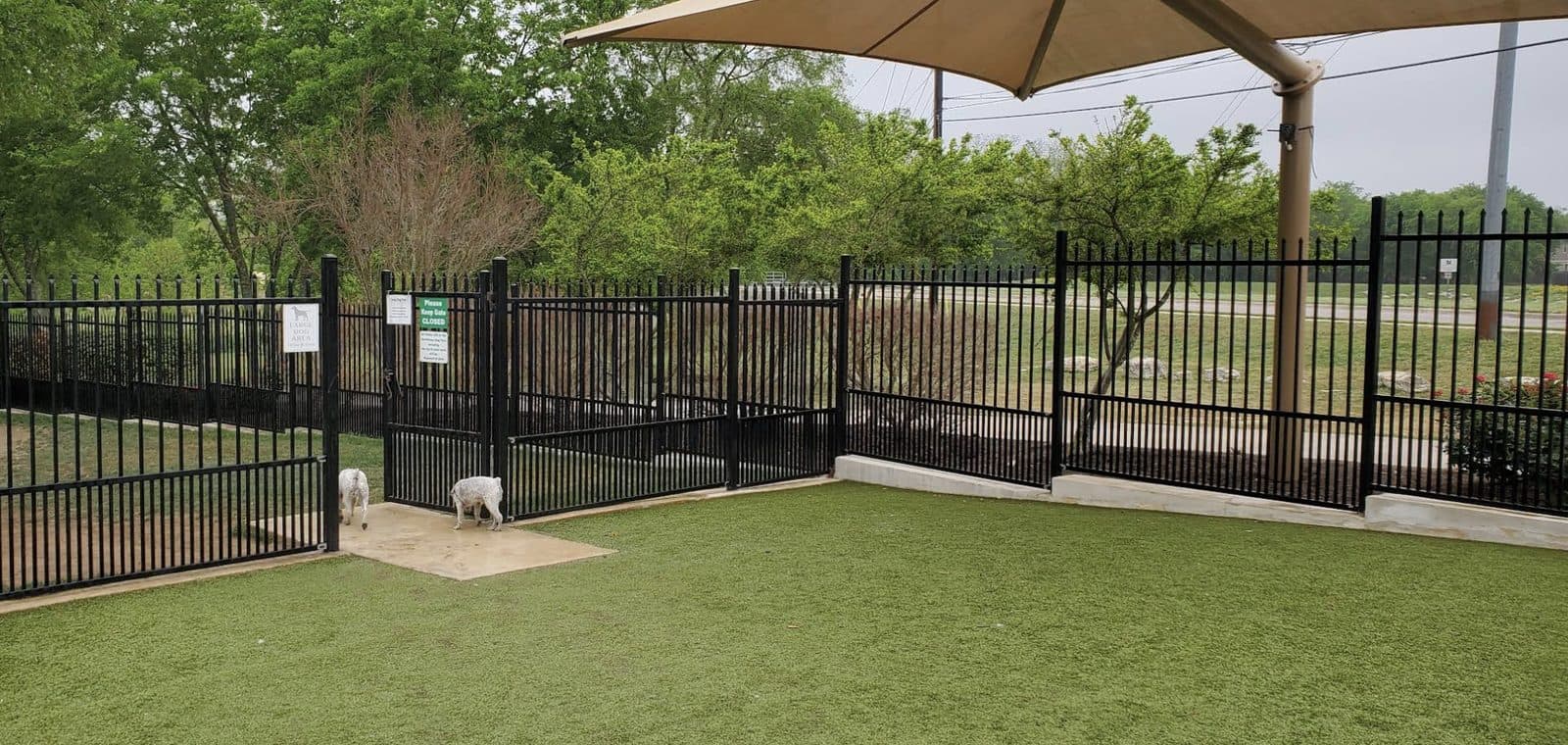
Northtown Dog Park sits inside the larger Northtown park complex on Harris Ridge Boulevard in Pflugerville, alongside a disc golf course, adult and children's soccer fields, volleyball and a pecan grove. It is run by the Northtown Municipal Utility District rather than a city parks department, so questions, closures and maintenance go to the MUD on (512) 716-0759 or manager@northtownmud.org — not to Pflugerville or Austin Parks and Recreation. You will see this park listed elsewhere as "Harris Ridge Dog Park," sometimes at 14400 rather than 14401. It is the same place. The MUD's own signage says Northtown. The large and small sides are separately gated and clearly signed, each entered through its own gate off a concrete apron. Much of the ground is artificial turf, which is the detail that most sets this apart from other parks in the area: it drains, it does not turn to mud, and it stays usable through a wet spell when a grass run would be churned up. Other sections are natural grass and packed dirt, so you get both surfaces in one visit. Shade sails cover part of the turf, and mature trees do the rest along the fence lines. There is agility equipment — ramps and similar — set out on the natural-surface section, along with tables, chairs and dog drinking fountains. **One rule that catches people out: anything left behind gets thrown out.** Posted signage states that all items left in the park, toys and water bowls included, are disposed of daily. If you bring a favorite ball, take it home with you. Hours are 7am to 9pm daily, and the park closes on weekends following rain to protect the natural-grass areas. It generally reopens once things dry out, but if it rained on a Friday night, check before loading the dog into the car on Saturday morning. House rules are stricter than a typical city park: no alcohol, no glass containers, no motorized vehicles. It sits just off I-35 near the Pflugerville and north Austin line, which makes it a practical stop for anyone commuting that corridor.
Norwood Estate Dog Park
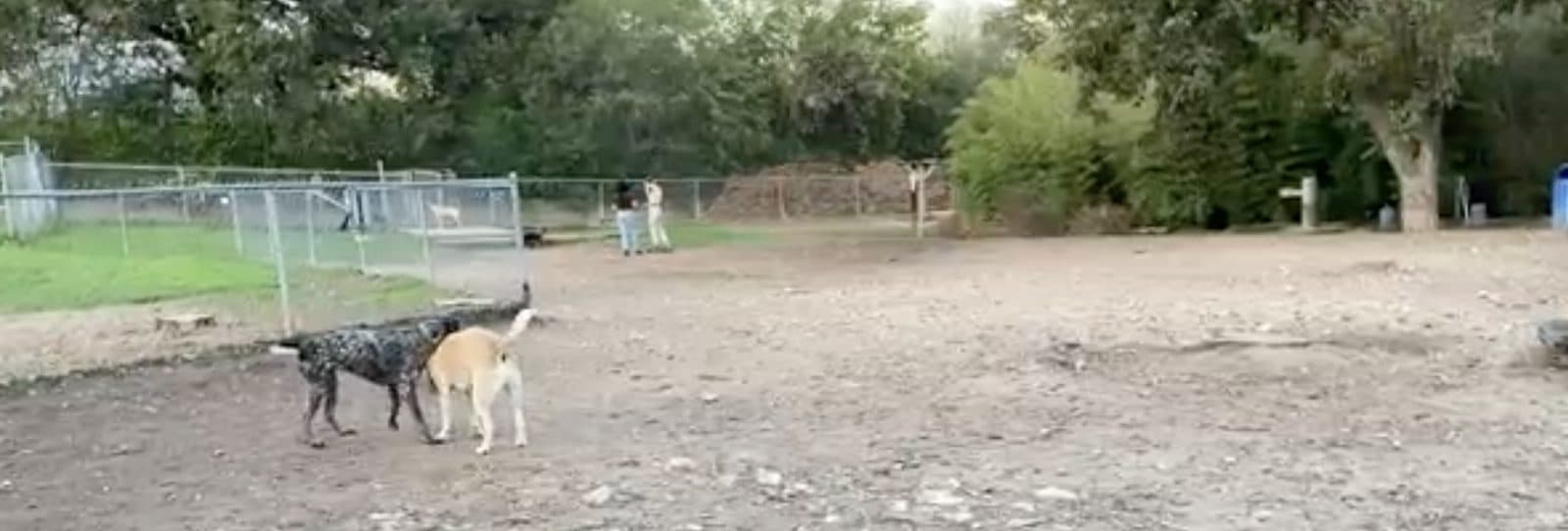
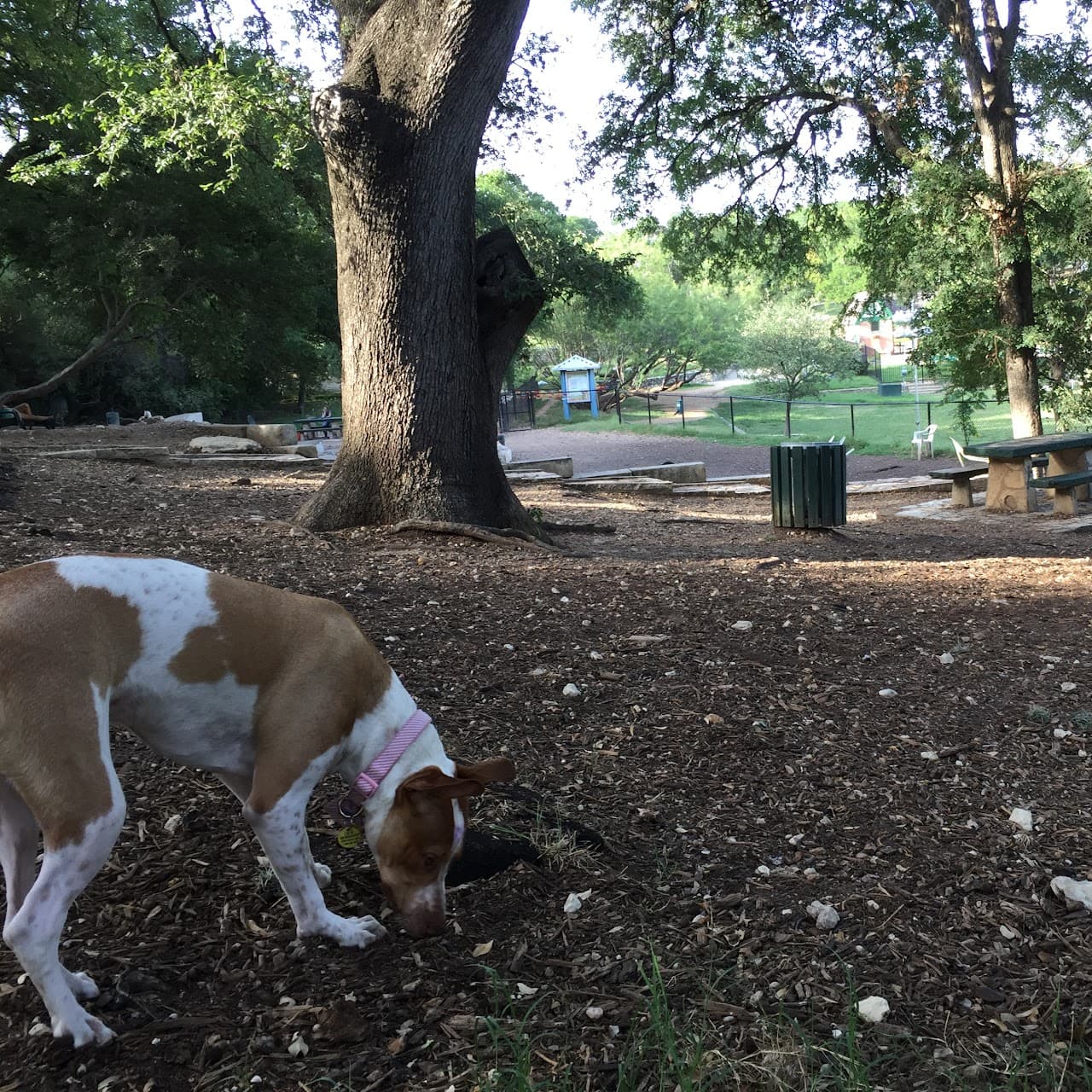
Norwood Estate sits on a bluff above Lady Bird Lake at the end of Edgecliff Terrace, and the thing regulars mention first is the shade. That is not a small detail in Austin. A good share of the city's fenced runs are open ground that turns punishing by ten in the morning from May through September, and the difference between a treed park and a bare one is the difference between a real visit and one lap of the fence before everyone gives up and goes home. The park is fully fenced, which puts it in the minority here — many of Austin's off-leash options are open greenbelt or unfenced lakefront where solid recall is the price of entry. Norwood has a double-gated entry and a genuinely separate small-dog section, not a token corner, so a nervous ten-pounder does not have to negotiate with a pack of labradors. Water, benches and waste stations are on site, and the ground is packed dirt and tree roots rather than turf, which drains quickly but does turn to mud for a day or so after heavy rain. Parking is free and immediately adjacent, which sounds mundane until you have circled Clarksville or Zilker for twenty minutes. On weekdays you will not think about it. Late weekend afternoons it fills. Worth being straight about the crowd, because it is the main reason people either make this their regular park or quietly stop coming: supervision here runs uneven. This is a busy park in a dense part of town, and on a given evening you may find several dogs whose owners are at the far end on their phones. That is true of urban dog parks generally, but it comes up about Norwood more than most. If your dog is reactive, or small enough to get bowled over by accident, mornings are noticeably calmer and the small-dog side is a real separation rather than a nominal one. The name comes from the Norwood House, the 1920s estate on the bluff above the park that has been under a long slow restoration. It is not part of the dog park and you cannot walk through it, but it explains the odd tucked-away approach — you turn off Riverside, the road narrows and drops, and it stops feeling like you are four minutes from downtown. **The posted rules are Austin Parks and Recreation's standard board, so most of this applies at the city's other off-leash areas too.** Twelve numbered rules, and several are easy to breach without realizing: - **No food and no treats.** Not just meals — training treats count. - **No puppies under four months.** - **No prong, pinch or choke collars.** Take them off before you go in. - **Children under 10 must be closely supervised.** - **No digging, and owners must fill in any holes their dog makes.** - Tags showing proof of registration and vaccination are required. - Dogs in heat are not permitted, and known aggressive dogs are barred. - One that surprises people: all dogs must be leashed **in the presence of a city employee**. Be realistic about the surface. The main run is worn dirt and gravel rather than grass — years of heavy use in a dense part of town have taken the turf off most of it, and after rain that becomes mud. The city has been restoring sections, so you may find fresh sod behind erosion matting and orange safety fencing marking off areas to stay out of. There is a water fountain with a dog bowl at its base and a hose bib beside it, set back under the bamboo where it is shaded most of the day. The view is the unexpected part. From the bluff on the north side you look straight across Lady Bird Lake at the downtown skyline — one of the better free views in the city, and not something you would guess from the approach.
West Austin Park
West Austin Park takes up a single block in Clarksville, and the off-leash area is a fenced section of it rather than the whole park. That distinction matters here more than at most places. Friends of West Austin Park, the volunteer group that helps look after the grounds, asks plainly that dogs stay leashed everywhere outside the fence, and the reasoning is practical rather than fussy: the open field runs right up against the playground and the pool, and an unfamiliar dog jogging toward someone's kid unsettles people no matter how friendly it is. Inside the fence it is a compact, heavily used run with water and waste bags on site. Most evenings bring the same faces, which is the real character of the place — a neighborhood park in the older sense, where people know each other's dogs by name and notice a new one. The rest of the block is worth knowing about if kids are coming along. The wading pool runs roughly 1 to 8pm for stretches of June through August, stays under four feet throughout, and has a lifeguard on duty. Restrooms are inside the 1930s Tudor-style bathhouse beside it. There is a playscape, a basketball hoop, a swing set tucked behind the pool, and picnic tables that cannot be reserved, birthday party or not. Parking is on the street in a dense neighborhood, so mornings are considerably easier than evenings. Inside the fence the city's usual conditions apply — vaccination and registration tags worn, no dogs in heat, no puppies under four months, and nothing edible brought in, treats included. Prong, pinch and choke collars come off at the gate.
Pro Tip: Small Dog Safety
Even in small dog areas, supervise closely. Some owners bring large dogs into small dog sections, which violates rules and creates danger.
Best Parks with Agility Equipment
Keep high-energy dogs engaged with obstacle courses and agility features. Perfect for athletic breeds who need mental stimulation.
Dog Depot Dog Park
The City of Round Rock calls this Dog Depot Dog Park on its parks pages and the Round Rock Dog Depot in its own descriptions of it; Google lists it under the latter. Same place either way, inside Lake Creek Park on Deerfoot Drive. Round Rock's off-leash park is Dog Depot, 1.85 fenced acres behind the Lake Creek Pool on Deerfoot Drive. Worth stating up front, because it trips people up: this is not at Old Settlers Park. Old Settlers is the bigger name in town and the one people assume, but dogs there are leash-only. The layout is unusual in a way that pays off. There are three sections instead of the usual two — a large dog area, a small dog area for anything under 40 pounds, and a rotation area the city closes off periodically so the grass can recover. That third section is why the footing here holds up better than at most parks getting this much traffic. The gates are winding sally-port entrances, which makes it much harder for a dog to slip past you on the way in or out. Agility equipment is spread through the large side: a tire jump, an A-frame contact ramp, and a tunnel. Two rules catch visitors off guard. No food of any kind is allowed inside, and that includes training treats. And every dog must be both vaccinated and microchipped — Round Rock states it directly rather than burying it in fine print. Hours shift seasonally: 6am to 8pm from April 1 through October 1, then 6am to 6pm from October 2 through March 31. Restrooms are at the Lake Creek Park pavilion outside the fence, in front of the pool, and there are hand sanitizer stations at the gates. The no-food rule deserves emphasis because it catches out anyone who trains with treats as a matter of routine. Round Rock means all food, not just meals, and the reasoning is straightforward: food in a shared enclosure is the most reliable way to start a fight between dogs that were getting along fine. **A navigation note worth having.** The monument sign at the park entrance reads "Lake Creek Park, 800 Deerfoot Lane," while the city's own website, and Google, both give the address as 800 Deerfoot **Drive**. Same place — the dog park sits behind Lake Creek Pool — but if a map app argues with the sign in front of you, the sign is the outlier. The entrance arch dates the park to 2008, and the western theming runs through the whole site: a timber windmill with a water trough at its base, a replica water tower, and rustic pergola shelters rather than the usual metal shade sails. It gives the place more character than the average municipal run, and the pergolas throw proper shade over the seating. There is also a stone-edged wading pool near the entrance, which on a hot afternoon is where you will find at least one dog refusing to leave. It is a genuinely popular park — on a decent weekend morning you can count twenty or more dogs across the large side — so if yours prefers quiet, the seasonal early opening at 6am is the window to use.
Georgetown Bark Park
The City of Georgetown calls this simply Bark Park — it was the city's first public off-leash park — and it sits on about six acres on Holly Street, next to the McMaster Complex. The pecan grove is the reason to choose it over a newer park. Most runs in the region are open turf with a couple of young shade structures; this one has mature canopy, which changes what an August afternoon feels like for everyone standing in it. There are two fenced enclosures, split at 30 pounds. That threshold is worth noting if your dog sits near the line, since several parks in the area draw it at 40 and Falcon Pointe posts pictures and leaves the judgment to you — a 35-pound dog is a large dog here and a small dog elsewhere. Both sides have dual drinking fountains serving dogs and people, benches, trash cans and Mutt Mitt dispensers. There is an agility course for dogs that want something to do beyond laps. **Georgetown posts a full rule set and a few items catch people out:** - **Dogs under four months are prohibited.** - **Two dogs per adult**, and every dog must be under an adult's control. - **No food or drink of any kind, for dogs or people — water is the only exception.** - **Spiked collars are not permitted.** - Rabies tags must be attached to the collar, with current license tags worn in the park. - Dogs in heat are prohibited, as are dogs with two documented incidents of aggression. - You must carry a leash at all times, and dogs must be leashed entering and leaving. - **Children under 12 require strict adult supervision**, and running or chasing dogs is prohibited. - No smoking, no glass containers. - Anything you bring in — equipment, waste, toys — has to leave with you. Bites must be reported to Georgetown Police on (512) 930-3510, and rule violations go to Parks and Recreation on (512) 930-3595 within 48 hours. Gates open at 5am and close at 10pm. Parking is on site. Georgetown is roughly 30 minutes north of central Austin, so this is a destination for most Austin residents and a neighborhood park for anyone in Williamson County. The pecan shade makes the drive more defensible in summer than it would otherwise be, and the park rarely reaches the density of the central Austin runs — dogs that find crowding stressful tend to do better here even accounting for the journey. Two things the photographs make plain that a listing never would. The pecan canopy is the real thing — not a few ornamental trees but a proper grove, with the shade spread across most of the enclosure rather than pooled under one structure. And the ground does not drain quickly. After rain, low spots hold standing water for a while, which some dogs treat as the main attraction and their owners treat as a towel problem. Summer swings the other way: by August the grass goes dormant and brown across the open stretches, which looks worse than it plays.
Harris Branch Dog Park
Harris Branch Dog Park is a small neighborhood run in the Harris Branch development in north-east Austin, off Harris Branch Parkway. It is fenced, with separate large and small dog sides connected within the same enclosure, double-gated entry, agility obstacles, benches and water. It is worth setting expectations honestly: this is a pocket park serving the surrounding subdivision, not a destination. Public ratings for it are noticeably lower than for the other fenced parks in this part of the city, and the recurring theme in reviews is size — the small-dog side in particular is compact, and on a busy evening the whole park can feel tight. If you have a dog that needs distance from others to stay comfortable, Northtown up the road is the roomier option. What it does offer is proximity. For anyone living in Harris Branch, Pioneer Crossing or the surrounding 78754 streets, this is a walk rather than a drive, and a fenced space five minutes from home gets used far more often than a better park twenty minutes away. Shade comes from young trees around the perimeter, so it is thinner than at the older parks and the middle is exposed in summer. Waste stations are provided and the grounds are generally kept clean. Parking is on the street alongside the park. Check current hours and any posted rules on arrival — this is a neighborhood facility and signage on site is the reliable source. Being a City of Austin facility, the standard parks board applies: no food or treats, no puppies under four months old, no prong, pinch or choke collars inside, tags showing registration and vaccination, and close adult supervision for children under ten. Owners are also expected to fill in any holes their dog digs.
Northtown Dog Park
Northtown Dog Park sits inside the larger Northtown park complex on Harris Ridge Boulevard in Pflugerville, alongside a disc golf course, adult and children's soccer fields, volleyball and a pecan grove. It is run by the Northtown Municipal Utility District rather than a city parks department, so questions, closures and maintenance go to the MUD on (512) 716-0759 or manager@northtownmud.org — not to Pflugerville or Austin Parks and Recreation. You will see this park listed elsewhere as "Harris Ridge Dog Park," sometimes at 14400 rather than 14401. It is the same place. The MUD's own signage says Northtown. The large and small sides are separately gated and clearly signed, each entered through its own gate off a concrete apron. Much of the ground is artificial turf, which is the detail that most sets this apart from other parks in the area: it drains, it does not turn to mud, and it stays usable through a wet spell when a grass run would be churned up. Other sections are natural grass and packed dirt, so you get both surfaces in one visit. Shade sails cover part of the turf, and mature trees do the rest along the fence lines. There is agility equipment — ramps and similar — set out on the natural-surface section, along with tables, chairs and dog drinking fountains. **One rule that catches people out: anything left behind gets thrown out.** Posted signage states that all items left in the park, toys and water bowls included, are disposed of daily. If you bring a favorite ball, take it home with you. Hours are 7am to 9pm daily, and the park closes on weekends following rain to protect the natural-grass areas. It generally reopens once things dry out, but if it rained on a Friday night, check before loading the dog into the car on Saturday morning. House rules are stricter than a typical city park: no alcohol, no glass containers, no motorized vehicles. It sits just off I-35 near the Pflugerville and north Austin line, which makes it a practical stop for anyone commuting that corridor.
Pro Tip: Agility Training
Introduce agility equipment gradually. Don't force your dog to use obstacles - let them explore at their own pace with treats and encouragement.
Best Shaded Parks for Summer
Tree cover and natural shade make these parks safer during Austin's brutal summer months. Essential for heat-sensitive breeds.
Bartholomew District Park
Bartholomew District Park in East Austin has one of the few fully fenced off-leash dog parks on the east side of I-35, making it a convenient option for dog owners in the Mueller, Windsor Park, and Govalle neighborhoods. The park has separate sections for small and large dogs, which helps keep size-mismatched interactions to a minimum and gives smaller dogs a safe space to run without getting overwhelmed. The fenced areas have a mix of grass and packed dirt, some shade trees, and water stations. The park isn't enormous, but for a neighborhood off-leash spot it's well-maintained and regularly used by a friendly, regular crowd. Weekend mornings tend to draw the biggest turnout — which is good for socialization but means the grass takes a beating during dry stretches. Bartholomew is located off Berkman Drive in the 51st Street corridor, with a parking lot off the main park entrance. The broader Bartholomew District Park also has sports fields, picnic areas, and a pool — so it's a full-service park with the dog area as one component rather than the entire property. The wider park is the reason to make it a longer stop. Bartholomew has a municipal pool, sports fields and picnic areas alongside the dog run, so the fenced area is one component of a full-service park rather than the whole destination — useful if someone in the group loses interest in watching dogs. Be realistic about the surface. The enclosure sees heavy daily use from a dense catchment, and in a dry stretch the grass gives way to packed dirt and dust. It recovers after rain, but midsummer is not when this park looks its best. The city's standard rule board applies here as at every Austin off-leash run. The two that catch regulars out are the ban on food and treats — training rewards included — and the requirement to remove prong, pinch or choke collars before entering. Puppies under four months are not permitted, dogs in heat are barred, and holes dug during a visit are the owner's to fill. **One thing to clear up before you go: Google shows a $9 admission for this park. The dog park is free.** That figure is the swimming pool fee. Bartholomew is one of Austin's regional pools, and the city charges daily entry there from AISD spring break through the end of October — $5 adult resident, $9 adult non-resident, less for children, seniors and juniors, free for under-ones and honorably discharged veterans. Google's listing has attached that pool admission to the whole park, which is why it looks like the park charges at the gate. It does not. Austin does not charge admission to city parks, and the fenced off-leash area, the trails, the disc golf course and the picnic areas are all free to use. You only pay if you are getting in the water — which is worth knowing the other way round too, if you were planning to combine a dog park trip with a swim on a July afternoon. The wider park is worth a walk beyond the fence line. The ground rolls rather than sitting flat — low rises and shallow draws with paved paths winding between them — and the tree cover is mature enough to matter, mostly pecan and native hardwoods spaced widely across open grass rather than crowded into a treeline. In spring the redbuds along the slopes come out pink before most of the canopy has leafed, which is the best few weeks of the year to be here. That undulating ground is also why the dog run drains better than some East Austin parks: water moves off it rather than sitting. The trade-off is that the open sections have no shelter at all in July, and the paved loops are exposed for most of their length.
Bull Creek District Park
Bull Creek District Park is one of the best places in Austin to be near water with a dog, and also one of the most misreported. It is worth getting the rules right before you go. **This is an on-leash park.** Austin Parks and Recreation removed off-leash privileges here after fecal contamination was found in Bull Creek and off-leash dog use was identified as the likely source. Plenty of what is written about the park online still describes it as a place where the leash rule is loosely observed at the water. We would rather not point you at that: the restriction exists because of a water quality problem in a creek that feeds into Lake Austin, and the dogs standing in it are the reason. Check the posted signage when you arrive, since rules here have changed before and may change again. None of which stops it being a lovely place to take a leashed dog. The limestone creek bed steps down through a series of shallow pools shaded by bluffs and mature trees, and it stays genuinely cool in the middle of a Texas summer when almost nothing else outdoors does. Wading in the shallows on a long lead is most of what people come for. Two cautions on the water. Swimming areas at Bull Creek have been closed at times over blue-green algae, which is toxic to dogs and can kill them — avoid still water with mats or scum on the surface, and rinse your dog afterwards. And the level swings hard with rainfall: after a dry spell the pools shrink to ankle depth, while after a storm the current through the rock channels is stronger than it looks. The footing is rough. This is a natural creek bed, not a groomed park — loose limestone, uneven slabs, and slick rock under the water. Dogs with joint problems or poor balance will find it hard work, and so will you in the wrong shoes. Access is off Lakewood Drive, just south of Loop 360. Parking is free but the lot is small and fills early on any decent weekend; before 9am or after 4pm gives you a realistic chance.
Dog Depot Dog Park
The City of Round Rock calls this Dog Depot Dog Park on its parks pages and the Round Rock Dog Depot in its own descriptions of it; Google lists it under the latter. Same place either way, inside Lake Creek Park on Deerfoot Drive. Round Rock's off-leash park is Dog Depot, 1.85 fenced acres behind the Lake Creek Pool on Deerfoot Drive. Worth stating up front, because it trips people up: this is not at Old Settlers Park. Old Settlers is the bigger name in town and the one people assume, but dogs there are leash-only. The layout is unusual in a way that pays off. There are three sections instead of the usual two — a large dog area, a small dog area for anything under 40 pounds, and a rotation area the city closes off periodically so the grass can recover. That third section is why the footing here holds up better than at most parks getting this much traffic. The gates are winding sally-port entrances, which makes it much harder for a dog to slip past you on the way in or out. Agility equipment is spread through the large side: a tire jump, an A-frame contact ramp, and a tunnel. Two rules catch visitors off guard. No food of any kind is allowed inside, and that includes training treats. And every dog must be both vaccinated and microchipped — Round Rock states it directly rather than burying it in fine print. Hours shift seasonally: 6am to 8pm from April 1 through October 1, then 6am to 6pm from October 2 through March 31. Restrooms are at the Lake Creek Park pavilion outside the fence, in front of the pool, and there are hand sanitizer stations at the gates. The no-food rule deserves emphasis because it catches out anyone who trains with treats as a matter of routine. Round Rock means all food, not just meals, and the reasoning is straightforward: food in a shared enclosure is the most reliable way to start a fight between dogs that were getting along fine. **A navigation note worth having.** The monument sign at the park entrance reads "Lake Creek Park, 800 Deerfoot Lane," while the city's own website, and Google, both give the address as 800 Deerfoot **Drive**. Same place — the dog park sits behind Lake Creek Pool — but if a map app argues with the sign in front of you, the sign is the outlier. The entrance arch dates the park to 2008, and the western theming runs through the whole site: a timber windmill with a water trough at its base, a replica water tower, and rustic pergola shelters rather than the usual metal shade sails. It gives the place more character than the average municipal run, and the pergolas throw proper shade over the seating. There is also a stone-edged wading pool near the entrance, which on a hot afternoon is where you will find at least one dog refusing to leave. It is a genuinely popular park — on a decent weekend morning you can count twenty or more dogs across the large side — so if yours prefers quiet, the seasonal early opening at 6am is the window to use.
Dog House Drinkery & Dog Park
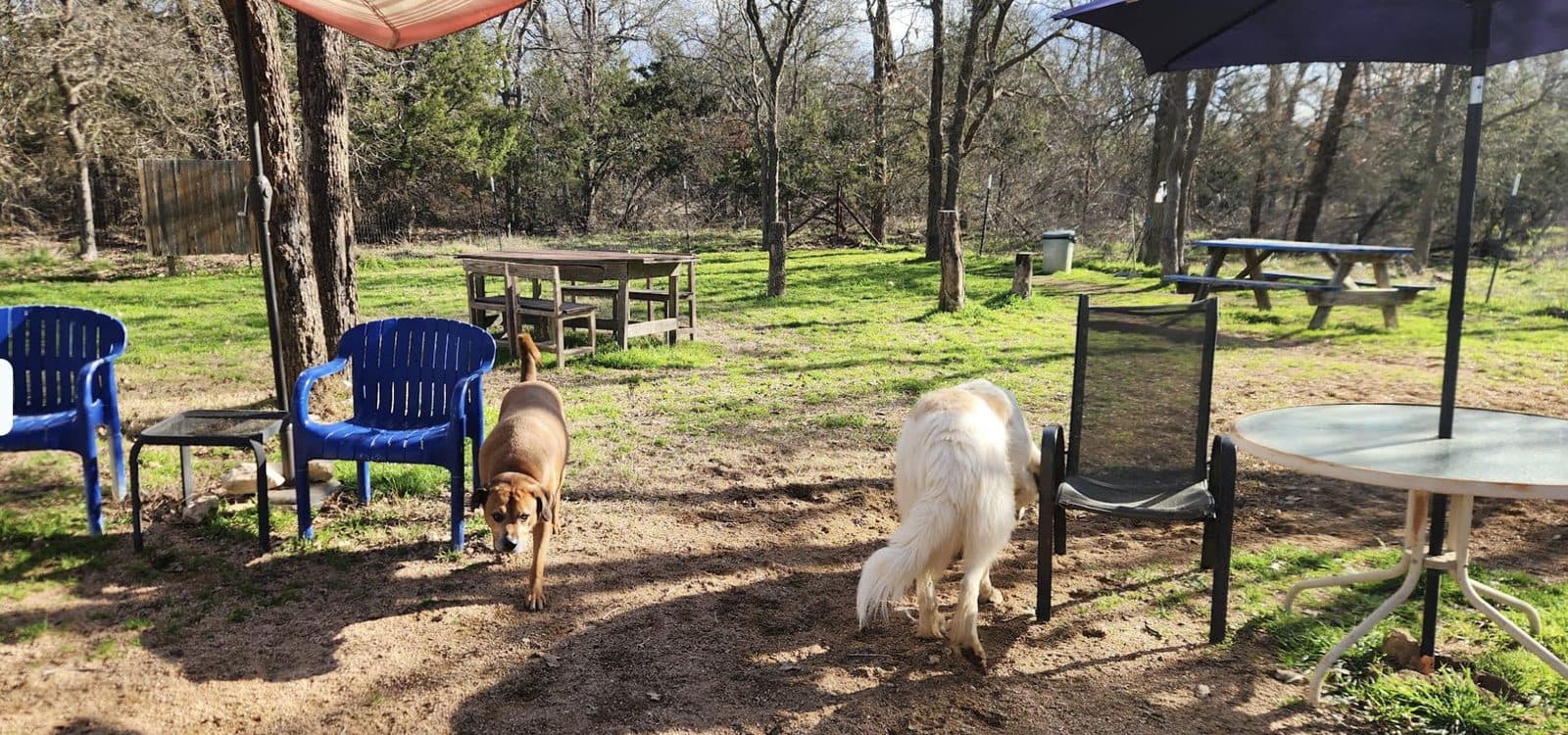
Central Texas' original off-leash dog park bar, running since 2013 — Dog House Drinkery sits in Leander, about 25 minutes north of downtown Austin, not in South Austin as its name might suggest to anyone going off memory. The dog area is a fenced half-acre yard with park monitors on duty, attached to a full bar with beer, wine, and seltzers plus shaded patio seating. It's closed Mondays (aside from occasional special events), then open Tuesday through Sunday with a $8 day pass or a $200 annual membership that covers one dog (additional dogs are $50/year each). Bring a copy of your dog's vaccination records — digital, tag, or paper all work, but they check. The crowd draws from Leander, Cedar Park, Round Rock, and Liberty Hill as much as Austin proper, so plan on the drive if you're coming from central or south Austin. A few rules catch people out. **The main park is 16 and over** — it is a bar with a dog yard attached, not a family venue, and the private event space is the part that accommodates younger visitors. Dogs must be spayed or neutered. Outside food is not allowed in the main yard, though food trucks turn up some evenings and there is a full bar inside. The referees are the real differentiator versus a public park. Staff are in the yard watching play rather than sitting behind a counter, and they will step in on a dog that is being a problem long before the owners would. If you have been put off public runs by unsupervised dogs, that supervision is most of what the entry fee buys. Beyond the yard there is indoor and outdoor dog-friendly seating, big-screen TVs, foosball and cornhole, so it functions as somewhere to spend an evening rather than a twenty-minute stop. Worth doing the arithmetic on the pass, though: at $8 a visit, anyone going weekly is better off on the $200 annual membership within about six months. The yard itself is a wooded lot rather than a lawn. Mature post oaks are spread through it, the ground is packed dirt and patchy grass under them, and the furniture is a deliberately mismatched collection of picnic tables, patio sets and plastic chairs scattered under umbrellas. String lights run tree to tree, which makes the evenings the best time to be there, and there are patio heaters out for the cold months — this is not a summer-only venue. Two details that matter more than the drinks list. There is a stock tank sunk at the base of one of the oaks, filled from a hose and usually holding a few tennis balls, and on an August afternoon there is a permanent queue of large dogs lying in it. And there is a covered pavilion running off the stone building, so a sudden Hill Country downpour does not end the visit. Inside, the bar is a proper room rather than a serving window: pool table, bar stools, taps and a concrete floor that makes sense the moment you think about wet dogs. Dogs come in with you. Events are a real part of the offer rather than an afterthought — paw-print painting sessions, trivia nights, themed evenings — and the social calendar is why a lot of the regulars treat it as somewhere to spend an evening rather than a place to exercise a dog for twenty minutes. One piece of logistics from the signage: non-members check in at the bar rather than walking straight through to the yard.
Domain Central Dog Park
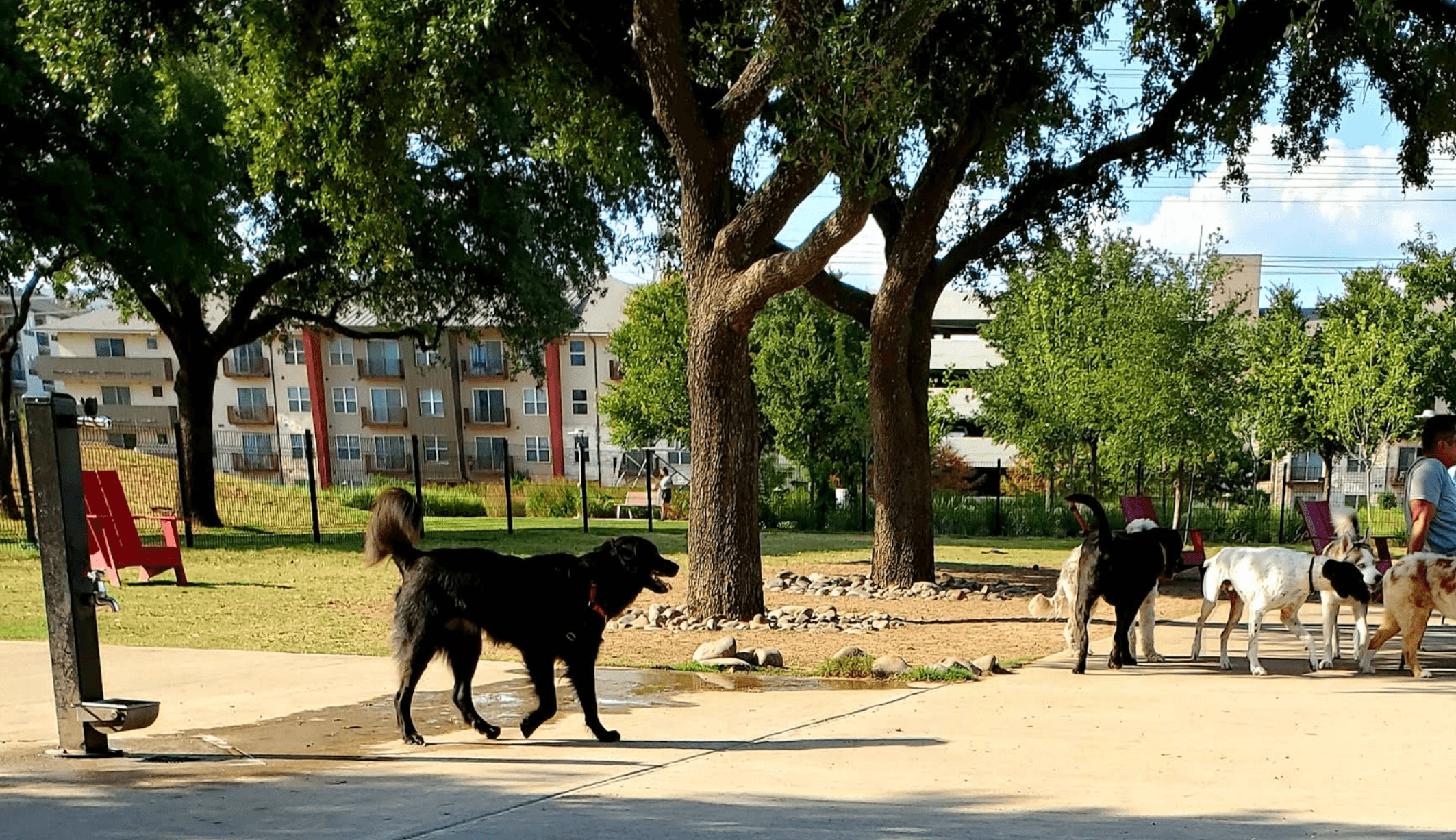
Domain Central Dog Park sits inside the Domain retail district in north Austin, off Alterra Parkway near the H-E-B. It is fully fenced with double-gated entry and separate large and small sides, which makes it one of the more forgiving places in north Austin to work with a dog that is not yet reliable off-leash. The park is not big. Mature trees give it decent shade and the grass holds up better than most heavily used city runs, because it is maintained by the property rather than the city — but at 5pm on a weekday, or on a Saturday morning, it fills, and a small fenced space with a lot of dogs in it is a different proposition from the same space at ten on a Tuesday. If your dog finds crowding stressful, the timing matters more here than the facilities do. What it has over almost every other option in north Austin is that it is embedded in somewhere you were probably going anyway. You can run the dog for half an hour and then do the grocery shop, or eat, without a second trip. Parking is in the Domain garages and the first two hours are free, which covers a normal visit comfortably. The mixed crowd is worth flagging. Because the district draws people from across the city rather than one neighborhood, you get more first-time visitors and fewer regulars who know each other's dogs than you would at a place like Hancock or West Austin. That cuts both ways — friendlier to a newcomer, less predictable in terms of who is watching their dog.

Emma Long Metropolitan Park
Emma Long is Austin's largest city park at 1,147 acres, running along the south shore of Lake Austin, and it is genuinely rugged — narrow winding access road, uneven ground, hill country terrain that feels a long way from town despite being inside the city limits. **Get the fees right before you go, because ours were wrong until recently and most listings still are.** Entry is **$5 Monday through Thursday and $10 Friday through Sunday and on holidays**, per vehicle. It is not free on weekdays. **There is a way around the fee if the off-leash area is your destination.** The leash-free area sits between City Park Road, the western boundary fence, Turkey Creek and the ridge above Lake Austin, and it is reached from the Turkey Creek Trail — where the parking lot sits *before* the pay station. Park there and the trail costs nothing. One honest caveat on that off-leash status. The city's trail directory lists Turkey Creek with an off-leash designation, while the park rules page states that pets must remain leashed and under control at all times. Those two city sources genuinely contradict each other. We are not going to tell you which to believe — check posted signage when you arrive, and if in doubt, a leash costs you nothing. Turkey Creek Trail itself is the main draw regardless: a shaded loop of roughly two and a half miles with repeated creek crossings, which makes it one of the better summer walks in Austin for a dog that likes water. Down in the main park there are several points of Lake Austin frontage where dogs can swim, plus primitive and improved camping, picnic areas and restrooms. Austin's guidance on toxic algae in local waterways applies here too — avoid still water with surface mats, and rinse your dog afterwards. Hours are 7am to 10pm. The road in from FM 2222 is narrow, winding and slow; allow more time than the distance suggests.
Pro Tip: Summer Visits
Even with shade, avoid peak heat hours (11 AM - 6 PM) in summer. Early morning visits in shaded parks are your best bet May-September.
Most Scenic Dog Parks
These parks offer stunning views, natural beauty, and Instagram-worthy backdrops. Perfect for dogs who love exploring diverse terrain.
Auditorium Shores Off-Leash Area
Auditorium Shores Off-Leash Area is Austin's most iconic dog park — a wide, open stretch of Lady Bird Lake waterfront where dogs run free against a backdrop of the downtown skyline. The off-leash area sits along the south shore of Lady Bird Lake near Barton Springs Road, giving dogs direct access to the lake for swimming while owners enjoy one of the best views in the city. On any given morning or evening you'll find dozens of dogs ranging from golden retrievers to pit mixes charging the water, chasing balls across the grass, and socializing with the regular crowd that shows up here daily. The park is unfenced — this is important. Auditorium Shores is a wide open space, not an enclosed dog park, so dogs need solid recall before you bring them here. The lake access is shallow and gradual near the off-leash zone, making it manageable for most dogs that like water. Parking is available in the lot off W Riverside Drive, though it fills up fast on weekend mornings. The surrounding trail connects to the larger Lady Bird Lake hike and bike trail, so many owners combine a dog park visit with a longer walk. Hours are 5am to 10pm daily. No fees. Leashes required outside the designated off-leash area. Waste bags and stations are available on-site. The park can get crowded on weekend mornings — if you have a reactive dog or prefer a quieter environment, weekday early mornings are the best window. Located at 900 W Riverside Dr, Austin, TX 78704, just west of the Lamar Bridge. Austin Parks and Recreation warns that toxic algae has been found in Lady Bird Lake and is most likely present in summer and autumn. It can be fatal to dogs, which are exposed both by drinking and by licking it off their coat afterwards. Avoid floating algae mats and scummy still water at the edges, and rinse your dog with clean water when you leave. Austin's published rules for unfenced off-leash areas are worth knowing here, because this is one of the busiest of them: keep your dog leashed walking to and from the area, keep them within sight and sound control throughout, dogs in heat are not permitted, rabies vaccination is required by state law, and waste has to go in a bin rather than be left at the edge of the grass.
Bull Creek District Park
Bull Creek District Park is one of the best places in Austin to be near water with a dog, and also one of the most misreported. It is worth getting the rules right before you go. **This is an on-leash park.** Austin Parks and Recreation removed off-leash privileges here after fecal contamination was found in Bull Creek and off-leash dog use was identified as the likely source. Plenty of what is written about the park online still describes it as a place where the leash rule is loosely observed at the water. We would rather not point you at that: the restriction exists because of a water quality problem in a creek that feeds into Lake Austin, and the dogs standing in it are the reason. Check the posted signage when you arrive, since rules here have changed before and may change again. None of which stops it being a lovely place to take a leashed dog. The limestone creek bed steps down through a series of shallow pools shaded by bluffs and mature trees, and it stays genuinely cool in the middle of a Texas summer when almost nothing else outdoors does. Wading in the shallows on a long lead is most of what people come for. Two cautions on the water. Swimming areas at Bull Creek have been closed at times over blue-green algae, which is toxic to dogs and can kill them — avoid still water with mats or scum on the surface, and rinse your dog afterwards. And the level swings hard with rainfall: after a dry spell the pools shrink to ankle depth, while after a storm the current through the rock channels is stronger than it looks. The footing is rough. This is a natural creek bed, not a groomed park — loose limestone, uneven slabs, and slick rock under the water. Dogs with joint problems or poor balance will find it hard work, and so will you in the wrong shoes. Access is off Lakewood Drive, just south of Loop 360. Parking is free but the lot is small and fills early on any decent weekend; before 9am or after 4pm gives you a realistic chance.
Garey Park
Garey Park's off-leash area is called the Dog Ranch, and it earns the name. Over four fenced acres of natural terrain rather than mown turf — brush, uneven ground, real cover — with separate enclosures for small and large dogs. For a dog that finds flat rectangles boring, this is a different kind of outing. Five shaded picnic shelters sit inside the fence, with water stations and dog-height drinking fountains. The shelters matter more here than at a neighborhood park, because most people stay longer than the usual twenty minutes. The Dog Ranch is one piece of a 525-acre former ranch on the South San Gabriel River, donated to Georgetown and opened to the public. Trails run down toward the water, there's fishing when the river is up, and 4.68 miles of equestrian trail if you ride. It sits about 6.5 miles west of I-35 on RM 2243. Two things separate it from everything else in this directory. It charges admission, and the fee is per vehicle rather than per person: $5 for Georgetown residents and $10 for non-residents, covering a driver and one passenger, with each additional person $2. Annual passes run $100 resident and $150 non-resident. And from October through March, entry is free on Tuesdays — the cheapest way to see whether the drive is worth it. Hours shift with the season: 8am to 8pm from April through September, 8am to 6pm from October through March. Nobody is admitted within 30 minutes of closing, and the park shuts on Thanksgiving, Christmas Eve and Christmas Day. Worth understanding what you are paying for, because Garey is not a drop-in neighborhood run. The entry fee, the drive and the seasonal hours all point the same way: this is a half-day out rather than a twenty-minute leg-stretch. The Dog Ranch is the anchor, but the wider 525 acres — river frontage on the South San Gabriel, trails, an equestrian area and a playground — are what justify the trip. The South San Gabriel is what lifts this above a fenced run with a fee. It comes through the property shallow and startlingly clear over pale limestone cobble, with wide gravel bars on the inside of the bends and slabs of rock big enough to sit on at the edge. In a dry spell it drops to ankle depth threading between exposed rock; after rain it moves. Either way the water is a different proposition from the muddy urban creeks further into Austin. The rest of the grounds are more manicured than the Dog Ranch suggests. There is a spring-fed pond with a fountain and a stone spillway, a pergola on limestone columns, and the restored Garey House with its tile roof looking out over the water — this was a working ranch given to the city, and the homestead end of it is kept accordingly. Beyond that the land rolls away into oak savanna and hill country views, which is where the trail mileage is. **One thing to keep straight: the Garey Play Ranch is not the Dog Ranch.** The Play Ranch is the children's area near the entrance — splash pad, playground, pavilions, its own gated arch and its own posted day-use rules. Dogs are not the point there. The off-leash Dog Ranch is a separate enclosure elsewhere on the property, so follow signs for that specifically rather than the first arch you see.
Mary Moore Searight Metropolitan Park
Mary Moore Searight is one of the few Austin parks with a dedicated off-leash trail rather than a fenced pen. The loop runs a little over a mile through the north end of the park, on natural surface through cedar scrub and live oak, with a shallow creek crossing partway round that most dogs will stand in rather than swim. The off-leash section is reached from 1st Street, south of Slaughter Lane. That matters, because navigating to the park's main Slaughter Lane address puts you at a different entrance with a fair walk to the dog trail. The loop is marked but not fenced. Dogs need to be under voice control, and the trail has enough tree cover and bends that a dog fifty yards ahead is genuinely out of sight. The upside of the same feature is that this doesn't have the penned-in intensity of a small fenced run — dogs walk rather than mill around, which suits a lot of dogs better than a crowded enclosure does. It's noticeably quieter than the central Austin parks. If your dog gets overwhelmed in a pack, or you'd rather not spend the visit managing introductions, the difference in atmosphere here is the main reason to make the drive south. There's no water at the off-leash trailhead, so bring your own — the creek is not a drinking source, particularly after rain moves street runoff through it. Parking at the trailhead is free and rarely full, even at weekends. Beyond the dog loop the park has miles of additional on-leash trail, a disc golf course and sports fields, so it's easy to extend the visit. Summer afternoons the shaded stretches of the loop do real work, but the open sections are exposed; mornings are the sensible window from June through September. Because the loop is unfenced rather than enclosed, the city's off-leash conditions matter more than usual: sight and sound control at all times, leashed on the way in and out, no dogs in heat, current rabies vaccination, and waste carried out to a bin. Two things the photographs add. First, the wildflowers are not incidental — the park posts "Wildflower Area, No Mowing" markers over sections of meadow, so the displays are deliberately managed rather than a lucky year. In a good spring the bluebonnets come in thick enough to carpet whole clearings, and by late summer the trailsides turn over to Maximilian sunflowers and Indian blanket. If you only visit once, March or April is the visit. Second, this is genuinely cedar-and-oak country rather than mown parkland. The trail runs as crushed granite in the developed sections and packed dirt further out, threading between Ashe juniper and live oak with cut deadfall stacked along the edges. It opens periodically onto low rises with long views south across the hill country. In winter the same ground reads very differently — bare, grey and quiet, with the leaf litter down and the structure of the scrub exposed. The trailhead carries a full Austin Parks board for the Slaughter Creek Greenbelt Trail, with a map, posted hours and the usual rules pictograms, plus a community noticeboard beside it. Worth a glance on arrival: the greenbelt trail network connects onward from here, so it is easy to extend a loop into a much longer walk than you intended.
Norwood Estate Dog Park
Norwood Estate sits on a bluff above Lady Bird Lake at the end of Edgecliff Terrace, and the thing regulars mention first is the shade. That is not a small detail in Austin. A good share of the city's fenced runs are open ground that turns punishing by ten in the morning from May through September, and the difference between a treed park and a bare one is the difference between a real visit and one lap of the fence before everyone gives up and goes home. The park is fully fenced, which puts it in the minority here — many of Austin's off-leash options are open greenbelt or unfenced lakefront where solid recall is the price of entry. Norwood has a double-gated entry and a genuinely separate small-dog section, not a token corner, so a nervous ten-pounder does not have to negotiate with a pack of labradors. Water, benches and waste stations are on site, and the ground is packed dirt and tree roots rather than turf, which drains quickly but does turn to mud for a day or so after heavy rain. Parking is free and immediately adjacent, which sounds mundane until you have circled Clarksville or Zilker for twenty minutes. On weekdays you will not think about it. Late weekend afternoons it fills. Worth being straight about the crowd, because it is the main reason people either make this their regular park or quietly stop coming: supervision here runs uneven. This is a busy park in a dense part of town, and on a given evening you may find several dogs whose owners are at the far end on their phones. That is true of urban dog parks generally, but it comes up about Norwood more than most. If your dog is reactive, or small enough to get bowled over by accident, mornings are noticeably calmer and the small-dog side is a real separation rather than a nominal one. The name comes from the Norwood House, the 1920s estate on the bluff above the park that has been under a long slow restoration. It is not part of the dog park and you cannot walk through it, but it explains the odd tucked-away approach — you turn off Riverside, the road narrows and drops, and it stops feeling like you are four minutes from downtown. **The posted rules are Austin Parks and Recreation's standard board, so most of this applies at the city's other off-leash areas too.** Twelve numbered rules, and several are easy to breach without realizing: - **No food and no treats.** Not just meals — training treats count. - **No puppies under four months.** - **No prong, pinch or choke collars.** Take them off before you go in. - **Children under 10 must be closely supervised.** - **No digging, and owners must fill in any holes their dog makes.** - Tags showing proof of registration and vaccination are required. - Dogs in heat are not permitted, and known aggressive dogs are barred. - One that surprises people: all dogs must be leashed **in the presence of a city employee**. Be realistic about the surface. The main run is worn dirt and gravel rather than grass — years of heavy use in a dense part of town have taken the turf off most of it, and after rain that becomes mud. The city has been restoring sections, so you may find fresh sod behind erosion matting and orange safety fencing marking off areas to stay out of. There is a water fountain with a dog bowl at its base and a hose bib beside it, set back under the bamboo where it is shaded most of the day. The view is the unexpected part. From the bluff on the north side you look straight across Lady Bird Lake at the downtown skyline — one of the better free views in the city, and not something you would guess from the approach.
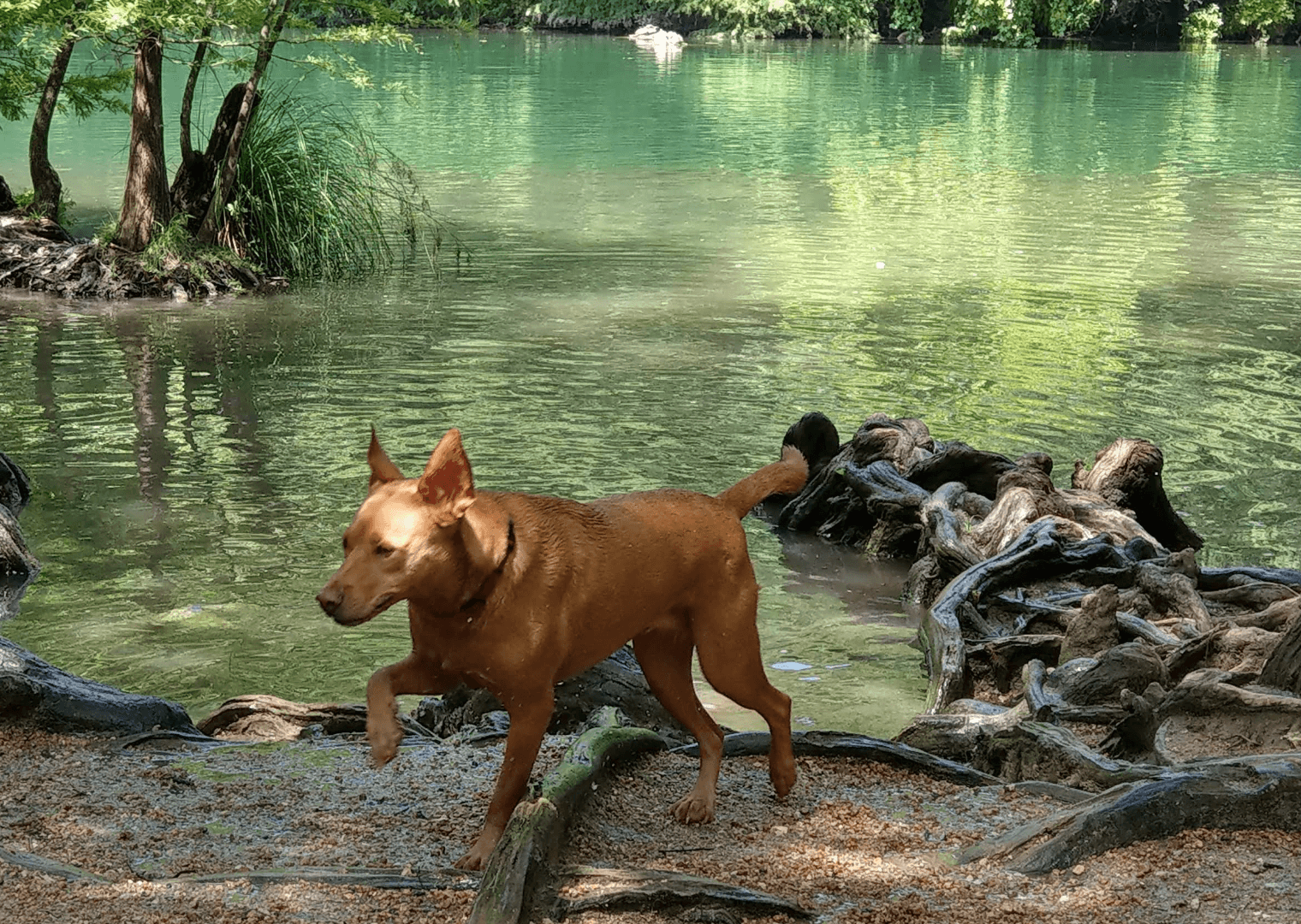
Red Bud Isle
Red Bud Isle is a narrow peninsula jutting into Lake Austin near Tarrytown — and it's one of the best off-leash spots in the city for dogs who love water. There's no fence, so recall is important, but for dogs that are reliable off-leash this place is hard to beat. Multiple creek and lake access points let dogs wade in or swim depending on water levels, and the wooded trails through cedar and oak keep things shaded even on hot Austin days. The entrance is off Redbud Trail just west of MoPac — look for the small parking area near the trailhead. Parking is free but the lot fills up fast on weekends and after work hours. Most regulars come early morning or on weekday afternoons to avoid the crowds. The trails are narrow and winding in spots, so larger packs of dogs can get a little chaotic at peak times. Bring water for your dog — there are no water stations on the peninsula itself. The terrain is uneven in places with exposed roots and limestone rock, so dogs with mobility issues may have trouble on some sections. Overall it's a natural, low-infrastructure experience: no lights, no facilities, no benches — just trees, water, and trail. For water-loving dogs in central Austin, it doesn't get much better. Austin Parks and Recreation warns that toxic algae has been found in Lady Bird Lake and is most likely present in summer and autumn. It can be fatal to dogs, which are exposed both by drinking and by licking it off their coat afterwards. Avoid floating algae mats and scummy still water at the edges, and rinse your dog with clean water when you leave.
Best Parks for High-Energy Dogs
Large, open spaces where your dog can run full-speed and burn serious energy. Ideal for athletic breeds and fetch enthusiasts.
Bartholomew District Park
Bartholomew District Park in East Austin has one of the few fully fenced off-leash dog parks on the east side of I-35, making it a convenient option for dog owners in the Mueller, Windsor Park, and Govalle neighborhoods. The park has separate sections for small and large dogs, which helps keep size-mismatched interactions to a minimum and gives smaller dogs a safe space to run without getting overwhelmed. The fenced areas have a mix of grass and packed dirt, some shade trees, and water stations. The park isn't enormous, but for a neighborhood off-leash spot it's well-maintained and regularly used by a friendly, regular crowd. Weekend mornings tend to draw the biggest turnout — which is good for socialization but means the grass takes a beating during dry stretches. Bartholomew is located off Berkman Drive in the 51st Street corridor, with a parking lot off the main park entrance. The broader Bartholomew District Park also has sports fields, picnic areas, and a pool — so it's a full-service park with the dog area as one component rather than the entire property. The wider park is the reason to make it a longer stop. Bartholomew has a municipal pool, sports fields and picnic areas alongside the dog run, so the fenced area is one component of a full-service park rather than the whole destination — useful if someone in the group loses interest in watching dogs. Be realistic about the surface. The enclosure sees heavy daily use from a dense catchment, and in a dry stretch the grass gives way to packed dirt and dust. It recovers after rain, but midsummer is not when this park looks its best. The city's standard rule board applies here as at every Austin off-leash run. The two that catch regulars out are the ban on food and treats — training rewards included — and the requirement to remove prong, pinch or choke collars before entering. Puppies under four months are not permitted, dogs in heat are barred, and holes dug during a visit are the owner's to fill. **One thing to clear up before you go: Google shows a $9 admission for this park. The dog park is free.** That figure is the swimming pool fee. Bartholomew is one of Austin's regional pools, and the city charges daily entry there from AISD spring break through the end of October — $5 adult resident, $9 adult non-resident, less for children, seniors and juniors, free for under-ones and honorably discharged veterans. Google's listing has attached that pool admission to the whole park, which is why it looks like the park charges at the gate. It does not. Austin does not charge admission to city parks, and the fenced off-leash area, the trails, the disc golf course and the picnic areas are all free to use. You only pay if you are getting in the water — which is worth knowing the other way round too, if you were planning to combine a dog park trip with a swim on a July afternoon. The wider park is worth a walk beyond the fence line. The ground rolls rather than sitting flat — low rises and shallow draws with paved paths winding between them — and the tree cover is mature enough to matter, mostly pecan and native hardwoods spaced widely across open grass rather than crowded into a treeline. In spring the redbuds along the slopes come out pink before most of the canopy has leafed, which is the best few weeks of the year to be here. That undulating ground is also why the dog run drains better than some East Austin parks: water moves off it rather than sitting. The trade-off is that the open sections have no shelter at all in July, and the paved loops are exposed for most of their length.
Barton Creek Greenbelt
The Barton Creek Greenbelt is one of Austin's most beloved outdoor spaces, and it's genuinely dog-friendly across its nearly 8 miles of trail — leashes are required, but the greenbelt's mix of shaded trails, limestone cliffs, and natural swimming holes makes it one of the best on-leash outings in the city. The creek runs through the entire length of the greenbelt, and multiple spots allow dogs to wade or swim depending on water levels. There are several access points: Barton Springs Road (most popular, fills up fast), Loop 360 at Spyglass, Campbell's Hole, and the Twin Falls entrance. The terrain varies from flat, packed trail near the main entrances to rugged, rocky sections with creek crossings further in. Dogs should be comfortable on uneven terrain for the longer sections. The payoff is real — deep, clear pools surrounded by limestone canyon walls with tree cover that keeps temperatures tolerable even in summer. Water levels vary dramatically with rainfall — after heavy rain, some sections can be inaccessible or unsafe. During dry summers, the swimming holes shrink but rarely disappear entirely. Weekends at the Barton Springs entrance are very crowded; the Twin Falls or Loop 360 entrances are better bets for a quieter hike. Bring water for both you and your dog on longer stretches since creek water quality varies. This is a go-to outing for Austin dog owners and worth the minor logistics. The swimming holes are what people actually come for, and they are worth knowing by name. Campbell's Hole is closest to the Spyglass access and the easiest to reach with a dog. Gus Fruh has deeper water and a cliff wall that draws climbers. Twin Falls and Sculpture Falls sit further south and take a proper walk to reach, which is exactly why they are quieter. How much water is in any of them depends entirely on recent rain. In a dry Austin summer the upper sections can run to standing pools or nothing at all, while the lower holes hold water most of the year. After a storm the creek moves fast enough through the narrow limestone sections to be genuinely dangerous for a dog. Two cautions on the water itself. Austin has recurring problems with toxic algae in its waterways, which can kill dogs — keep them away from mats and scum on still water and rinse them off afterwards. And creek water quality here varies with runoff, so bring drinking water rather than letting your dog rely on the creek. Footing is the other thing to plan for. Much of the greenbelt is loose limestone, exposed root and rock shelf rather than groomed trail. It rewards a sure-footed dog and punishes a clumsy one, and the same goes for whoever is holding the leash.
Bob Wentz Park at Windy Point
Bob Wentz Park is a Travis County park on the north shore of Lake Travis, and there are several things to sort out before you drive out, because a fair amount of what gets written about it online is wrong. It is not free. Day use is $5 per person, $3 for seniors 62 and over, and no charge for children 12 and under or for disabled veterans at 50 percent or greater. **The entrance booth takes cash only** — no cards, no phones, no exceptions — and people do get turned around at the gate over this. If you end up coming often, the $80 Travis County resident annual permit covers day use here and at eight other county parks. Dogs must be leashed everywhere in the park. Off-leash is explicitly prohibited, so despite the swimming this is a lake outing with your dog rather than a dog park in the usual sense. The bigger catch is The Point. That small sandy peninsula with the covered picnic tables and the easiest water access is exactly where you would want to take a dog, and **pets are not allowed on it at all**. Plenty of visitors find this out after parking. There is still plenty of shoreline elsewhere in the 211 acres, but it is rockier limestone rather than sand, so bring something for your feet and expect a less gentle entry into the water. Two water cautions that matter more for dogs than for people. The LCRA advises keeping dogs away from floating algae mats on the Highland Lakes and rinsing them with clean water after they swim — toxic algae has been a recurring problem on Austin waterways and it can be fatal to dogs that lick it off their coat. Zebra mussels have also been found along the shoreline, and their shells are sharp enough to cut paws in the shallows. The park is a well-known windsurfing and sailing spot, which tells you what the conditions are like: it is genuinely windy most days and the surface gets choppy. That is fine for wading and shoreline fetch, less good for a dog inclined to strike out for the middle of the lake. Hours are 8am to 8pm daily, and the gate stops admitting new entries thirty minutes before closing. On holiday weekends the park fills and then closes to all incoming traffic for the rest of the day, including people on foot, so an early start matters more here than at a city park. Drinking fountains, restrooms, showers and covered picnic tables are on site. It is roughly a 30-minute drive from downtown, which along with the entry fee makes this a deliberate weekend trip rather than a stop on the way home.
Cedar Bark Park
Cedar Bark Park is five fenced acres inside Veterans Memorial Park on West New Hope Drive. It is not at Elizabeth Milburn Park, which is a separate Cedar Park facility a few miles away and a common mix-up. The draw here is water. There's a dog pond for swimming and, more unusually, dog showers on site — so the muddy retriever who just discovered the pond doesn't have to ride home that way. Drinking fountains, waste stations, and benches are spread through the grounds, and the site keeps a fair amount of natural landscape rather than being scraped flat and sodded. Check the day before you drive over, because the maintenance schedule closes the park on two mornings a week. Tuesdays it stays shut from 7am until 3pm, and Fridays from 7am until 11am, while the city services the wash stations and clears trash. Every other day runs 6am to 10pm. Cedar Park asks visitors to be diligent about picking up, and the reason is specific rather than generic: waste left near the pond ends up in the water the dogs are swimming in. The pond is a genuine one rather than a splash pad — a fenced basin with an aerating fountain in the middle and a short dock along one edge. The bank is gravel with a concrete ramp giving dogs a gradual way in and out instead of a drop, and on a warm afternoon there are usually a few standing in the shallows near the ramp rather than swimming properly. Entry is through a double gate, and the small and large sides are split at 30 pounds. In the large field there is a dachshund-shaped tunnel that puppies find considerably more interesting than the adult dogs do.
Dog Depot Dog Park
The City of Round Rock calls this Dog Depot Dog Park on its parks pages and the Round Rock Dog Depot in its own descriptions of it; Google lists it under the latter. Same place either way, inside Lake Creek Park on Deerfoot Drive. Round Rock's off-leash park is Dog Depot, 1.85 fenced acres behind the Lake Creek Pool on Deerfoot Drive. Worth stating up front, because it trips people up: this is not at Old Settlers Park. Old Settlers is the bigger name in town and the one people assume, but dogs there are leash-only. The layout is unusual in a way that pays off. There are three sections instead of the usual two — a large dog area, a small dog area for anything under 40 pounds, and a rotation area the city closes off periodically so the grass can recover. That third section is why the footing here holds up better than at most parks getting this much traffic. The gates are winding sally-port entrances, which makes it much harder for a dog to slip past you on the way in or out. Agility equipment is spread through the large side: a tire jump, an A-frame contact ramp, and a tunnel. Two rules catch visitors off guard. No food of any kind is allowed inside, and that includes training treats. And every dog must be both vaccinated and microchipped — Round Rock states it directly rather than burying it in fine print. Hours shift seasonally: 6am to 8pm from April 1 through October 1, then 6am to 6pm from October 2 through March 31. Restrooms are at the Lake Creek Park pavilion outside the fence, in front of the pool, and there are hand sanitizer stations at the gates. The no-food rule deserves emphasis because it catches out anyone who trains with treats as a matter of routine. Round Rock means all food, not just meals, and the reasoning is straightforward: food in a shared enclosure is the most reliable way to start a fight between dogs that were getting along fine. **A navigation note worth having.** The monument sign at the park entrance reads "Lake Creek Park, 800 Deerfoot Lane," while the city's own website, and Google, both give the address as 800 Deerfoot **Drive**. Same place — the dog park sits behind Lake Creek Pool — but if a map app argues with the sign in front of you, the sign is the outlier. The entrance arch dates the park to 2008, and the western theming runs through the whole site: a timber windmill with a water trough at its base, a replica water tower, and rustic pergola shelters rather than the usual metal shade sails. It gives the place more character than the average municipal run, and the pergolas throw proper shade over the seating. There is also a stone-edged wading pool near the entrance, which on a hot afternoon is where you will find at least one dog refusing to leave. It is a genuinely popular park — on a decent weekend morning you can count twenty or more dogs across the large side — so if yours prefers quiet, the seasonal early opening at 6am is the window to use.
Emma Long Metropolitan Park
Emma Long is Austin's largest city park at 1,147 acres, running along the south shore of Lake Austin, and it is genuinely rugged — narrow winding access road, uneven ground, hill country terrain that feels a long way from town despite being inside the city limits. **Get the fees right before you go, because ours were wrong until recently and most listings still are.** Entry is **$5 Monday through Thursday and $10 Friday through Sunday and on holidays**, per vehicle. It is not free on weekdays. **There is a way around the fee if the off-leash area is your destination.** The leash-free area sits between City Park Road, the western boundary fence, Turkey Creek and the ridge above Lake Austin, and it is reached from the Turkey Creek Trail — where the parking lot sits *before* the pay station. Park there and the trail costs nothing. One honest caveat on that off-leash status. The city's trail directory lists Turkey Creek with an off-leash designation, while the park rules page states that pets must remain leashed and under control at all times. Those two city sources genuinely contradict each other. We are not going to tell you which to believe — check posted signage when you arrive, and if in doubt, a leash costs you nothing. Turkey Creek Trail itself is the main draw regardless: a shaded loop of roughly two and a half miles with repeated creek crossings, which makes it one of the better summer walks in Austin for a dog that likes water. Down in the main park there are several points of Lake Austin frontage where dogs can swim, plus primitive and improved camping, picnic areas and restrooms. Austin's guidance on toxic algae in local waterways applies here too — avoid still water with surface mats, and rinse your dog afterwards. Hours are 7am to 10pm. The road in from FM 2222 is narrow, winding and slow; allow more time than the distance suggests.
Pro Tip: High-Energy Dogs
Bring a ball or frisbee (but be prepared to share or put it away if other dogs become possessive). Large parks give you space to tire out energetic dogs safely.
Quick Feature Comparison
| Park Name | Water | Small Dog Area | Agility | Shade |
|---|---|---|---|---|
| Auditorium Shores Off-Leash Area | ✓ | - | - | - |
| Bartholomew District Park | ✓ | ✓ | - | ✓ |
| Barton Creek Greenbelt | ✓ | - | - | - |
| Bob Wentz Park at Windy Point | ✓ | - | - | - |
| Bull Creek District Park | ✓ | - | - | ✓ |
| Cedar Bark Park | ✓ | ✓ | - | - |
| Dog Depot Dog Park | ✓ | ✓ | ✓ | ✓ |
| Dog House Drinkery & Dog Park | - | - | - | ✓ |
| Domain Central Dog Park | - | - | - | ✓ |
| Emma Long Metropolitan Park | ✓ | - | - | ✓ |
Match Parks to Your Dog's Personality
For Water-Loving Breeds (Labs, Retrievers, Spaniels)
Choose parks with lake or creek access where your dog can swim and cool off.
Top Picks: Red Bud Isle, Auditorium Shores, Bull Creek
For Small or Senior Dogs
Look for separate small dog areas and parks with calmer atmospheres.
Top Picks: West Austin Dog Park, Emma Long Metropolitan Park, Norwood Estate
For Shy or Nervous Dogs
Choose smaller, quieter parks during off-peak hours where your dog can build confidence gradually.
Top Picks: Visit any park on weekday mornings (7-9 AM) when crowds are minimal
For High-Energy Athletes (Border Collies, Huskies, Aussies)
Spacious parks where your dog can run full-speed and burn energy.
Top Picks: Zilker Metropolitan Park, Walnut Creek Metropolitan Park
For Social Butterflies
Popular parks with consistent crowds and lots of playmates.
Top Picks: Dog House Drinkery (private, admission fee), Auditorium Shores, Zilker
Choosing the Right Park
The "best" dog park is different for every dog. Consider these factors when choosing:
- Your Dog's Size: Small dogs need separate areas or quieter parks
- Energy Level: Match park size to your dog's need for space
- Water Interest: Swimming dogs thrive at lake parks
- Socialization Level: Nervous dogs need gradual exposure at quieter parks
- Heat Tolerance: Thick-coated breeds need maximum shade and water access
- Drive Time: Closer parks = more frequent visits = better socialization
Explore Multiple Parks
Don't limit yourself to one park. Variety helps your dog generalize socialization skills and prevents territorial behavior. Try visiting 2-3 different parks regularly to give your dog diverse experiences and keep visits interesting.
Explore Austin Parks by Feature
Browse some of Austin's most popular parks, each with something different to offer.